
“HISTORY DOESN’T REPEAT ITSELF—BUT IT RHYMES.” *

EMR September 2025

Dear Reader,

The current economic environment is generally defined or considered to be rather unique, despite there being a long history of change. Being interested in the relevance of developments, both current and long-term, we are aware of factors that are not adequately addressed in press reports and recent studies. We like to remember that price trends, as demonstrated by long-term data available in the United States, tell a story of continuous change, sometimes minor, sometimes dramatic and difficult to assess. Therefore, we should bear in mind that inflation is a persistent problem, one that we may have to deal with not only in the immediate future.
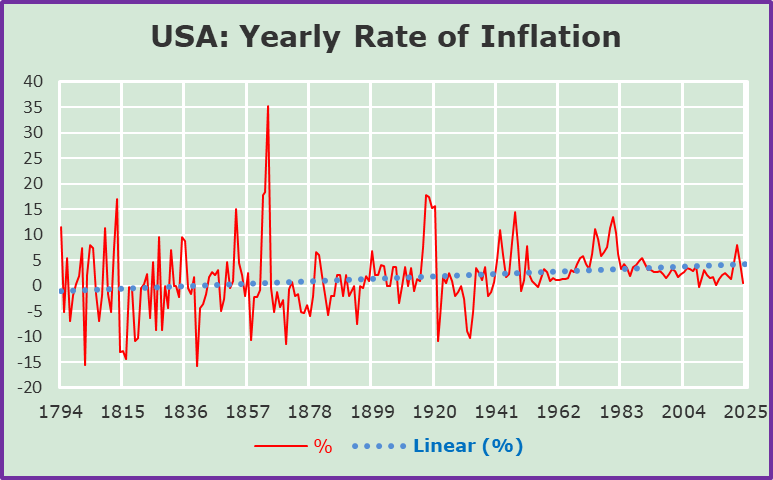
What can be inferred from the US CPI inflation chart, considering that the average inflation rate for the period from 1872 to the present amounts to 2.37%, with a maximum of 17.84% and a minimum of -10.94%? Let us emphasize that the overall average trend—dotted line—has been slightly rising, while the recent trend (since 2000) indicates a significant slowdown.

Furthermore, it should be noted that the rate of change has been significantly higher in the period prior to 1870 than in the period thereafter. The graph also shows that the overall deviation for the period between 1980 and the early 1960s has been fairly modest.

The inflationary trend since the late 1970s has been surprisingly “moderate.” Without going into details about inflation trends, since the late 1970s we note a downward trend compared to the previous period. The reasons for this are not easily quantifiable, aren’t they?

Without examininsg the develomenats of inflation trends in other countries and currencies, to answer the above posed question, let us summarize key events that, so far, have had – and still might have – a decisive impact. Although the following list imight not be exhaustive, we believe it to be quite significant for the current forecasting outlook.

  1. On January 20, 2025, Mr. Trump was inaugurated as president of the United States for a second non-consecutive term.
  2. On April 9, 2025, he announced the suspension of customs duties for a period of 90 days, with the exception of China.
  3. On April 17, 2025, he attacked Fed Chairman Powell with the statement, “When he leaves, it will be too late.”
  4. On May 8, 2025, he signed a trade agreement between the United States and the United Kingdom.
  5. On May 11, 2025, China and the United States signed a 90-day suspension
  6. On May 16, 2025, Moody’s downgraded the United States’ rating from “AAA” to “Aa1.”
  7. On May 23, 2025 Mr. Trump announced 50% duties to Europe.
  8. On June 21, 2025 the U.S. bombs sites of Iran for uranium enrichment.
  9. On July 8, 2025 Mr. Trump extended the deadline for new agreements to August 1, 2025 (e.g. tariffs on copper of 50% and also 200% tariffs on pharmaceuticals).
  10. On August 7, 2025, he did not “chair” the meeting with the high-level Swiss delegation at the White House.
  11. Meeting in Alaska, August 15, 2025, between US and Russian presidents, Donald Trump and Vladimir Putin, was billed as a promising step towards peace in Ukraine. According to press information no ceasefire and an invitation to Moscow, were announced! The meeting yielded more questions than answers.

Now let us ask ourselves what can we deduce from the long-term U.S. inflation chart, taking into account the above listed developments regarding the economic outlook and financial market trends?

BETWEEN PAST AND FUTURE

The current political and economic environment is quite complex, making it difficult to assess with a high degree of certainty and precision. Even a fairly simple analysis of price changes reveals that, on many occasions, we have faced economic and social contexts that were difficult to predict. Price inflation, as we all know, has been a persistent and challenging problem, one that we may continue to face. not only in the near future, but also in the longer term. In the economic literature, we have found specific phases, that began in a very similar way to what is happening now. The phases that come to mind indicate similar starting points and, at times, divergent paths, known as stages. A “simple” review of price changes shows, as implicitly illustrated in the chart above, that we have almost always faced considerable difficulties in forecasting. We therefore assume that price inflation could persist and, with the active support of President Trump, could be a serious forecasting obstacle not only over the short term but also in the longer term. In the economic literature, we find certain phases that begin very similarly while leading to different outcomes. At this point, we would like to point to four main phases, illustrating current forecasting difficulties:

  • A first phase might be defined as a phase of “quiet beginnings, and also of slow progress”.
  • A second, slightly different phase, is characterized by the “overcoming” of previous price limits. The contextual and deterministic factors were wars and/or changes in the system of government, as well as drastic increases in the prices of raw materials such as crude oil.
  • A third phase concerns the hypothesis that “price changes are due to inflation expectations,” i.e., changes in long-term trends. A particular limitation concerns the assumption that investors believe that the trend may require an expansion or contraction of the money supply. At this stage, the rate of change in the money supply is considered the relevant indicator which, in due course, would confirm to some extent the assumptions of an increase/decrease in inflation. In this context, economists refer to financial market instability.
  • Finally, the fourth wave “peaks and breaks down with shattering force”, with dramatic consequences, including recessions and political change

It should be borne in mind that each phase had significant social consequences and that each price trend exhibited common wave structures of varying duration and scope.

Implicitly “visible” in the above shown chart are also the respective effects on the medium-term inflation outlook.

Currently, as in the past, there will be social and economic disparities also on a country-by-country basis. Even today forecasters should seriously consider the implicit impacts on the asset allocation exercise.


The recent meeting between US and Russian presidents, Donald Trump and Vladimir Putin, in Alaska was billed as a vital step towards peace in Ukraine. As we see it, without a ceasefire and an invitation to Moscow, the meeting has yielded more questions than answers.

OUTLOOK DETERMINANTS

At this crossroads, we believe that the determining factor in the current forecasting exercise concerns the inflationary repercussions of Trump’s fiscal mania. Therefore, we disagree with the vast majority of analysts who believe that monetary measures are the most promising course of action for economic growth. We do not see how the monetary actions of the Fed, or any other central bank, should be the primary deterministic actions, given the dramatic inflationary impact of Trump’s fiscal stance. The meeting between the US and the Russian presidents, D. Trump and V. Putin, in Alaska, can be billed as a vital step towards peace in Ukraine. With no ceasefire and an invitation to Moscow, the meeting has yielded more questions than answers.

EXPECTATIONS

Our specific assumptions are based on the following setting:

  1. As in previous EMRs, we persevere in favoring primarily investments in our home market: Switzerland followed with coherent judgement by investments in Europe and a significant underexposure to the USA.
  2. Our currency expectations continue to favor the CHF and EUR, less so the JPY, and even less so the USD. We are concerned about the persistent devaluation of the USD in line with Trump’s absurd fiscal policy and the US administration’s “anti-FED” stance.
  3. Somehow, we disagree with the assumption that interest rate cuts in the USA ought to be viewed as the primary motor of economic activity. The center of economic policy is set on “increases in import-taxation” boosting fears of inflation.
  4. In our opinion, investors will avoid the US market, favoring the European markets and, to a lesser extent, the Japanese market, as an appropriate response to the absurd policy of the US president.
  5. At this point, we wonder whether it would be appropriate to start hedging equity exposures against their respective currencies in USD.

Dear reader, we would really appreciate to know your coherent assessment?

* Mark Twain

Facebooktwitterlinkedinmail

EQUITY RECORDS: WHAT NEXT?

EMR August 2025

Dear Reader

What can be deduced from the performance of selected share indices for the recent past and the foreseeable future is, at this crossing, the real question, isn’t it?

In order to answer the above quoted question, let us first summarize which key events we define as having been deterministic. The list may not be ex-haustive, nevertheless we still consider it meaningful.

  1. For the first time, on January 20, 2025, Mr. Trump was installed in the White House.
  2. On April 2, 2025, Mr. Trump announces duties to the world
  3. On April 9, 2025, he announces the suspension for the duration of 90 days of duties, excluding China.
  4. On April 17, 2025, he attacks the chairman of the FED, Mr. Powell, with the statement “When he leaves it will be too late”.
  5. On May 8, 2025, he signed a trade accord between the USA and the UK.
  6. On May 11, 2025, China and the USA signed a 90-day suspension.
  7. On May 16, 2025, Moody’s downgraded the rating of the U.S. from “AAA” to “Aa1”.
  8. On May 23, 2025, Trump announced 50% duties to Europe.
  9. On June 21, 2025, the U.S. bombed sites of Iran for uranium enrichment.
  10. On July 8, 2025, Trump extended the deadline for new agreements to Au-gust 1, 2025, (e.g. tariffs on copper of 50%, and also 200% tariffs on pharmaceuticals).

In addition, let us ask ourselves: What can be deduced from the chart of Eq-uity Indexes, expressed in local currencies? Is it primarily the unexpected “superb performance” of the German DAX index, while keeping in mind its currency developments? So far, the weakest indexes have been the NIKKEI, followed rather closely by the DJIA, and the NASDAQ, as well as the SPI. While most commentators are focused on the astonishing – to say the least – policy of the US president, one might face a dilemma analyzing the economic environment.

A further surprising result is shown by the poor performance of the so-called economic fundamentals, which, to us, appear to be misplaced by the so-called instantaneous arbitrage. If share indices represent the “new” funda-mentals, then one could conclude that real economic facts, such as economic activity, are currently being “played off” by the short-term or instantaneous return of capital.

Another contextual puzzle, as implicitly shown in the above shown chart of the USD/CHF developments, refers to the deterministic repercussions of currencies. While the chart on equity indexes describes the growth trend of each index, the currency chart speaks of sizeable volatility on a month’s end basis. The real question at this crossing is: Why is there such a disparity in the specific trends of equities and currencies?

Contextually, we argue that the fundamentals, at least for the short-term outlook, matter less and less. In other words, they represent specific difficulties in defining a rewarding investment outlook.

OUTLOOK DETERMINANTS

Should our assessment assume that the fundamentals (Consumption, Business Fixed investments, Government outlays and international trade) are no longer in the driver’s seat of the developments of coming months and quarters, then we must reckon with increasing difficulties for Central Banks.

The main difficulty to be assessed relates to the outcome of the Trump administration’s ambiguous policy of erratic and at times absurd taxation versus the needs and requirements of the Federal Reserve in managing interest rates. The relevant question relates to the likelihood of a recession not only in the US.

Contextually, we can also ask ourselves the following: What is the risk for investors, given that the stock market, at least in the short – to medium term, may become more of a race against the “signal” than a reflection of the real value of a specific stock and/or index. In this context, the price of a stock looks more like an algorithm than of a human valuation. Therefore, investors need to understand whether it is more important to them how much they gain, or lose, than the ultrafast robots. In this context, we face a difficult question: “Do we understand what it means to play in a field where it is not the invisible hand of the economy that controls the situation, but the ultra-fast hand of a software program?”

PERSONAL ASSESSMENT

As long as Mr. Trump is “free to act and react to his own opinion and stance” the outlook remains hardly quantifiable. Coherently, we persist in setting the investment focus on our domestic equity market, Switzerland, particularly taking into account the traditional revaluation of the home-currency and the dramatic, expected further devaluation of the USD.

INVESTMENT CONCLUSIONS

International diversification will need to be discussed and implemented in accordance with each client’s expectations, tailored to their risk aversion.

Suggestions are welcome.

Facebooktwitterlinkedinmail

INVESTORS PREOCCUPATIONS

EMR July 2025

Dear Reader,

DEBT AND INVESTORS

Factors worrying investors do not seem to concern the ups and downs of stock indices, the price of gold or even the price of oil, but rather the yields on interest rates (e.g. the yield on 10-year government bonds), which are mainly due to the policies of the Trump administration. This is where the de-terministic lines cross in terms of confidence, liquidity and, above all, the sus-tainability of the economic system and the financial system in particular.

At this point let us recall when the Trump presidencies took place. Donald Trump was first inaugurated on January 20, 2017, as the nation’s 45th presi-dent and his presidency ended on January 20, 2021. Joe Biden served as his successor. Trump was then elected for a second, nonconsecutive term in 2024 and assumed the presidency again on January 20, 2025, as the nation’s 47th and current president.

Examining the graph of 10-year government bond yields for the period since March 2005, we see that the downward trend bottomed out with the election of successor, Joe Biden. Since Biden took office, 10-year government bonds yields have risen rather differentially. U.S. and British rates have outpaced German, Swiss, and Japanese rates, implying a differential impact on a na-tional basis. Readers might recall that trend differentials are indicating an un-stable outspeaking of a high level of forecasting uncertainty.

We should bear in mind that the economic situation in the years 2006 to 2008 has been strongly determined by the outbreak of the global financial crisis and the corresponding impact on the global economy. The crisis, which began in the United States with the bursting of the real estate bubble, had far-reaching consequences for the financial markets and the real economy throughout the world.

Examining the chart of 10-Y Govt. bond yields and taking into account that the recent spread is primarily due to the risky U.S. policy, focused on taxing U.S. imports, thus disrupting fiscal policy, not only at the U.S. level, but also on a global scale. The U.S. financial deficit must be financed, which in the long run leads to the potential for sharply rising interest rates. Markets evidently fear the servicing of this debt, interpreting it as a systemic macroeconomic problem that the current U.S. administration cannot or will not handle. At this crossing we are somehow worried by the politically induced calls of analysts and politicians to request additional interest rate increases. We should not forget to examine the developments of the equity indexes for the period since e.g. 2008. Actually, this is what we are interested in, in the following chapter.

SUGGESTIONS FROM US & SWISS REAL GDP & COMPONENTS

The graphical representation of the quarterly whereabouts of real GDP and main components, in Switzerland and the USA, shown in the following charts is indeed telling. The discrepancies must be taken seriously, with regard to the short- and medium-term outlook. Turning our attention to recent quarters, mainly as a result of the Trump administration’s taxation policies, we find that most forecasters are concerned with the recent developments. The shown real GDP data speak volumes, particularly in terms of the misrepresentation of the policies pursued by the US administration.

The data portrayed in the chart of US GDP and components, undoubtedly point to the primarily impacts of exports and imports and partially also on fixed investments, specifically in Q1 2025. Let us ask the reader to examine the growth rates of GDP, Consumption (C) and Government spending (G) for the US as compared to Swiss developments.

While the focus in the media is set on interest rates expectations and corresponding reactions on the currency front, in both charts, we see the impact of international trade, which is mainly due to Trump’s erratic tax imposition, as the primary determinant of the current economic whereabouts.

Surprising is the increase (!) in imports (M) in the first quarter of 2025 for both Switzerland and the United States, especially when compared to the limited increases in 10-year government bond yields. Looking at the graphs of Swiss and U.S. economic activity, we see an extraordinary dependence on international trade, that is, exports and especially imports, conditioned by the U.S. administration, predominantly visible in the first quarter of 2025. We wonder why on earth, we feel so alone in assessing the economic environment on the basis of international trade, instead of following the herd, which focuses its rationale mainly on interest rates to counter inflation as the main determinant of economic expectations and thus economic activity in the coming quarters. Of course, we will certainly see some developments in fixed investment and U.S. interest rates in the coming quarters, but not as the most crucial determinants.

OUTLOOK DETERMINANTS

Forecasting is a challenging exercise, determined primarily by specific assessments of the political, economic and social environment, based mainly on hard data. Currently a further difficulty concerns the whereabouts in the Middle East. The setting is currently really difficult to quantify.

While most analysts set theirs focus on inflation vs. interest rate changes as well as currencies ups and downs, we set our focus in the components of real GDP and particularly on exports and imports of goods and services.

PERSONAL POINT OF VIEW

The next months and quarters remain hardly quantifiable. Coherently, we persist in setting the investment focus on our domestic equity market, particularly taking into account the traditional revaluation of the home-currency and the dramatic, expected further devaluation of the USD.

INVESTMENT CONCLUSIONS

International diversification will need to be discussed and implemented in accordance with each client’s expectations, tailored to their risk aversion.

Suggestions are welcome.

Facebooktwitterlinkedinmail

TRUMPS IMPACTS?

EMR June 2026

Dear Reader,

TIPS FROM SHARE INDEXES

Not a day goes by without President Trump, or another American political leader making a specific, relevant and/or surprising statement. Just think of the absurd export/import tax proposals, which began with the introduction in the United States of the import of certain goods from Canada, Mexico, and China starting in April 2025. Politicians and the media in general comment on announcements that are economically nonsensical, to say the least, without so far contributing to a promising scenario for inflation and inflation expectations, nor for economic activity in general or for the stabilization of currencies.

At this point we propose to examine recent developments by means of specific stock and currency indices, for the period between April 22, 2024 and May 30, 2025, recalling that the all-time low occurred on April 24, 2025.

Till 30.05.25

Looking at the data – of daily closing values of selected stock indexes – at first glance, one might be somewhat puzzled by the deviations shown in the chart above. Consistently, we believe that it is worth examining what the recent developments disclose. The data confirm that the leading economy, the U.S. market, is governed by growing fear of instability, whether political, social, revelatory or simply schizophrenic actions and reactions. In particular, we accept the following as plausible:

  • The period leading up to Donald J. Trump’s inauguration as president of the United States on January 20, 2025, is characterized by significant disproportions among the various indices in terms of levels and trends.
  • The phase following Trump’s recent inauguration is even more volatile than the previous one!
  • To be able to assess recent developments, we analyze the highs and lows of each phase. The first phase, which runs from April 22, 2024, to January 17, 2025, shows significant developments from index to index, both in terms of explicit levels and respective trends. The developments speak of significant disparities, both in the medium and in the longer term. The trends of most indices indicate sideways fluctuations. The SPI is the best performing index along with the NASDAQ. However, the two indices have reacted differently to the determinants. The SPI rose by 33.1% mainly due to the attractiveness of the Swiss franc, while the NASDAQ’s performance (+24.3 %) has mainly been driven by technological innovation.
Till 30.05.25

The second phase highlights – so far – President Trump’s actions from January 20, 2025 and May 20, 2025. The chart points to specific factors driving each index. Volatility is significantly more pronounced than in the first phase. In addition, the chart shows greater disparities between the indexes before and after March 2025.

Till 30.05.25

OUTLOOK DETERMINANTS

We believe that at this time there are two main factors determining the outlook. The first factor relates to the danger of an economic recession, both in the United States and in other countries, while the second relates to the loss of the triple-A status of U.S. bonds, which exacerbates fears and the cost of refinancing U.S. debt. In this EMR, we ask ourselves what the relevant consequences are that determin the economic outlook and the possible reactions of equity markets.

The recent developments confirm that President Trump is not known for consistent and relevant policy decisions. As we all know, he has announced high taxes on imports of goods, e.g., from Canada, Mexico and China, and many other countries, and then reduced them one after another. Meanwhile, many of his decrees have been changed or cancelled. The reasons for these changes are the real puzzle, according to which we believe both the economic outlook and the focus on U.S. government bond interest rates will change. These changes are and continue to remain deterministic, as we believe they will change both the economic outlook and the deterministic impact on interest rates and inflation and inflation expectations on the position of government bond rates.

The absurd import tariff interventions by various U.S. trading partners, have shifted the focus on economic growth from domestic activity to international trade, with a devastating impact on domestic bond rates and, in due course, on financial instruments. The contextual fact is that Moody’s, until May 19, 2025, has refused to remove the triple “A” rating from sovereign debt, the last of the so-called Big Three! An ominous signal regarding U.S. sovereign debt. This attitude could be interpreted not only as a significant signal to President Trump himself, but also to his Administration.

In a decision that could affect U.S. and global financial markets, Moody’s has downgraded the credit rating of the United States. The reason is the $36 trillion national debt and the Trump administration’s plans for new tax cuts, which are only partially covered by those for health care, ecological change and social welfare. The absurd interventions in the form of import tariffs by various U.S. trading partners have, in our view, shifted the focus of economic growth from domestic activity to international trade, with a devastating effect on domestic bond yields.

As is well known, the “higher” tariffs have a similar effect to an additional tax and primarily hinder personal consumer spending and, with a time lag, business investment and government spending as well as international trade.

PERSONAL POINT OF VIEW

The Trump administration, so far in 2025, has relied on tariffs of imported goods as a means of economic management. Clearly these costs, must be expected to increase consumer and business prices. Therefore, tariffs are expected to have an impact on overall inflation, primarily impacting, in due time, consumer and business fixed investment spending. In the current forecasting exercise this policy requests the exact quantification of how much consumption and/or investment imports contribute to overall inflation, taking the respective possible actions / reactions by the FED into consideration.

Similarly to the consumption spending impact of tariffs, one ought to assess also the import content of different types of equipment used in the U.S. production process as well as the possible repercussions on and of exchange rates. This due to the fact that domestic markups tend to be smaller for investment goods than for consumer goods, making, as one might assume, the import content of the respective costs much larger.

INVESTMENT CONCLUSIONS

Currently we view the following factors as the primary determinants of a most promising investment outlook:

  1. The whereabouts of inflation is and remains the primary determinant for a promising investment approach. We assume that the inflation trend will continue to have a deterministic influence on imports and exports of consumer and capital goods. Furthermore, we assume that prices for capital goods will remain significantly stronger, i.e. deterministic, than prices for consumer goods exports. We have no doubt that our expectations should play a deterministic role in asset allocation.
  2. The developments of the trade balance are a further deterministic element of economic activity, particularly regarding consumer and investment.
  3. While monetary actions and reactions of the U.S. and foreign Central Banks are generally viewed as the most promising and determining anti-inflation factor, we assume, in the current phase, that the primary means to control inflation and interest rates ought to be a return to “political normalcy” by the US President.
  4. What is definitely trend deterministic is a more coherent policy by the U.S. President, via a limitation of interference in the economic and fiscal policy, including more international cooperation, in other words, less America First policy, and more economic interplay.

Our specific assessment continues to speak, at least for Swiss franc investors, of a significant over-exposition to Swiss instruments and the Swiss franc.

Suggestions are welcome.

Facebooktwitterlinkedinmail

FISCAL MEASURES and REVERSALS?

EMR May 2025

Dear Reader,

BACKGROUND

Before considering the economic effects of the extraordinary events of the 100 days of the Trump administration it is useful to review the politics behind the moves. President Trump is a man in a hurry, because he believes that he was significantly hampered in his first term, 2016 – 2019, and he is aware that the Republican Party is likely to lose its majority in the House of Representatives in the coming midterm elections, less than two years away. The traditional road map or an agreement in tariffs involves many months – sometimes years – of meetings by respective trade representatives, followed by a compromise, that may not satisfy all parties. Based on his limited time frame, President Trump chose to promulgate punitive tariffs and apply them immediately. This has the effect of getting everyone‘s attention and then permits him to scale back the tariffs on trade talks come to a satisfactory conclusion. The most interesting concept was his idea of reciprocal tariffs, whereby he claims that if the exporting county reduces its tariffs on US goods to zero, he will reduce American tariff to zero as well.

There is no assurance that this tariff strategy will work. Most countries seem to agree with customs negotiations. The paradox is that by a significant upheaval in the equity and debt markets – both domestically and overseas, President Trump could arrive at a genuinely free-trade global marketplace much sooner than anyone could have expected. That is the plan. In the meantime, we can expect the volatility to continue at rates we have not seen in a generation.

In early May 2025, President Trump, once again, backtracked on his earlier decision to tax several countries, announcing a 90-day suspension of his decision to introduce universal tariffs designed to affect goods and services from more than 150 countries. However, he left unchanged, the previously introduced 25 percent duties on steel and aluminum from Europe and lowered duties on goods and services exported from Europe to 10 percent. At the same time, he increased duties to 145% on goods from China, but excluding smartphones and computers. However, these tariffs have recently been reduced again to 30% and a 90-day moratorium has been agreed. China reduced its tariffs from the announced 115% to 10%.

The announcements of the above-mentioned, contradictorily applied measures, have had and continue to have a major impact on equity markets, including the US itself. The recent interventions by the US president have had a deterministic impact and, are likely to continue to reduce total factor productivity (TFP). We emphasize this aspect as currently it is not openly discussed, although in economics several factors can be identified as boosters of productivity, defined as output per hour.

In today´s context we find that labor productivity does not rise over time because workers do not have more and/or enough capital to work with, nor due to lacking and/or costly supply of imported goods and services, as much as due to unilateral and as much as due to one-sided political perilous decisions. In publicly made comments we find no clear explanation of the negative repercussions of the policy decisions by President Trump on US domestic economic activity. Therefore, let us stress and keep in mind that the policy is determined both by domestic and foreign factors; impacting economic growth via a specific lack of “induced costly” capital. In addition, US productivity does not grow over time, solely or primarily due to lacking and costly imports, but due to higher “home-made” taxation.

A further aspect, rather difficult to be assessed, concerns the impact of negative repercussions on productivity as a consequence of Trump’s taxation of compulsory imports of specific goods. Contextually, we find no assessment of the negative repercussions on domestic economic activity, and particularly on productivity. These developments do not portend a flamboyant economic recovery in in the coming quarters.

What do the daily closing data of selected equity indexes, portrayed in the following Chart, tell us about the markets´ valuations of the current political and economic outlook? Any suggestions?

The chart starts one day prior to the U.S. presidential elections of November 5, 2024. Examining closely the respective ups and downs of the shown indexes, expressed in the respective currencies and indexed to 1 on October 2024, the following may be deduced:

a) Overall, the ups and downs follow similar movements, with varying shorter-term disparities.

b) The DAX-index is shown as the overall outperformer.

c) The overall underperformers have been the NIKKEI index, followed by the NASDAQ and the SX5P indices. The disparities stress the incongruent sectoral content of each index!

d) The only index that did not lose ground, since the beginning of the period under consideration, has been the DAX-Index. De facto it is the only index that did not lose ground during the period following the Trump’s Tax-announcements.

The differential growth rates of the studied indices are astonishing indeed and at the same time quite problematic. Do these differences indicate an important and peculiar functioning of the individual national indices?

OUTLOOK

This raises the question of how to respond to the measures and decisions that are likely to be taken by President Trump in light of the unstable socio-economic situation. Would it not be much more promising to analyze the reactions of the various markets in accordance with the political and social influences of total factor productivity (TFP)? In the current context, these influences call on us to focus on innovative investments. While the focus in the US is on controlling foreign trade, we in Europe, and particularly in Switzerland, should focus on the use of ICT (information and communication technology), which contributes significantly more to labor productivity through capital deepening. We consider the focus on “taxes” to be a political stance that is unlikely to be successful, as it does not promote productivity through capital deepening. The information we gather from relevant US commentary suggests that foreign investment in the US is increasing, while it is rather difficult to find employers. The medium-term outlook does not seem to support the US government’s tax policy.

Given this situation, we are leaning toward an investment approach that under-weights US equities in favor of domestic equities and, selectively, equities from Eu-rope and Asia.

In terms of currencies, we are pursuing an approach with an overweight position in the Swiss franc and a slightly lower exposure to the euro and pound sterling. We also expect volatility to remain very high, depending on the unpredictable policies of the White House.

Suggestions are welcome.

Facebooktwitterlinkedinmail

GROWTH vs. RECESSION?

EMR April 2025

Dear Reader

SETTING

In our EMR March 2025, we dealt with the inappropriate stance taken by President Trump, imposing new tariffs on imports from Canada, Mexico and China, although, as announced in the meantime, these may not be implemented, as announced! In the present EMR, we set the focus on the implications of the measures, i.e. the impacts on economic activity, in order to make appropriate financial investment decisions. Of particular interest here are the economic laws, according to which demand falls or rises when the price of a particular resource, product or commodity changes. On the supply side, the opposite effect is postulated.

Contextually, we ask ourselves what the implications might be regarding the supply and/or the demand side. Fact is, that the demand principle states that demand falls when the price of a particular resource, product or commodity rises. Coherently, on the other hand, demand increases when prices fall. Taking the publicly known decree of the US government to levy specific taxes on the countries quoted in the above paragraph, we assume that prices for the specific goods will rise in the country levying the tax, the USA, while supply is likely to remain stable or even be reduced.

In the meantime, President Trump has signaled the reversal of his “logic” by announcing that he will suspend tariffs against Mexico from March 7, 2025. Despite this “glimmer of hope”, the US President announced two more tariff hikes to begin in April.

When reviewing the “politically induced” price announcements, we should not ignore the respective impacts on corporate fixed investment and consumer spending in the country levying the taxes. Specific reactions can be alleged in the following chart of selected equity indices. For comparison purposes, we have indexed each index to 1 as of January 2, 2020. We kindly ask the reader to take note that the indices are denominated in the respective country’s currency.

What does the chart highlight, any suggestion? To improve comparability let us set the focus on the following determinants:

  • 2020: Outbreak of Covid.
  • 2021: Signs of recovery, climate change, competition between China and USA.
  • 2022: Start of the Russian aggression against Ukraine.
  • 2023: End of Covid.
  • 2024: US tax impositions to Canada. Mexico and China.
  • 2025: Actions and reactions to tax increases, and particularly the nomination of Stephen Miran as Chairman of the National Economic Council (in charge since March 2025).

We ask ourselves, which of the above mentioned factors might or ought to be used while forecasting the whereabouts in the ongoing year 2025? Well, taking the multiple explanations into serious consideratation we come to the following conclusions:

The example concerning Canada, Mexico and China is really helpful, as an inflation determinant both in the tax-levied countries as well as the leving country itself, the USA.

Consequently, we view the path of the growth oulook or exports f. impoorts of goods and services as a highly deterministic factor. The growth rate e.g. of Swiss exports has exceeded that of imports for almost the entire period, while accompanied by persistent volatility. The growth rate of US imports has increasingly outpaced that of US exports, especially in the last 10 years.

In addition, the different trend developments of the respective currencies should also be analyzed more closely.

At this point, one may ask what these trend differentials mean for interest rates as well as currency management of the respective monetary authorities?

EXPECTATIONS

We believe that the year 2025 will be dominated by recessionary developments. Why, you may ask? We present our best guesses below.

Without a turnaround in the taxation of raw material imports by the USA, it must be assumed that there will not be significant economic growth improvement in the tax imposing country, if the price of “primary raw materials” continues to be politically increased. Higher “import costs” lead both to higher inflation in the country levying the tax and consequently also to a slowdown in consumer and investment spending.

Furthermore, we note that the US administration has highlighted a plan to weaken the USD, for countries with high USD currency reserves, such as Switzerland. This plan is indeed threatening, as it determines both the economic growth path and the function of the USD as a reference currency. Its main function ought to improve financial stability by allowing investors, traders and governments to compare and assess the value of currencies, while promoting international trade and thus economic growth both in the country where the tax is levied and, in the country, levying the tax. The negative impact of Trump’s “America first” stance is expected to make the economic environment even more difficult, making it really hard to determine the right value of goods and services.

CONSEQUENTIAL PERSPECTIVE

Clear signs of disagreement with the White House’s “official” position were given by the FED, which kept interest rates unchanged (March 19, 2025) at 4.25% to 4.5%, and the SNB which – on March 20, 2025 – reduced the interest rate by 0.5% to 0.25%, indicating the approaching end of 0% for Switzerland!

A further indication of incongruent development might be deduced from the relationships of the gold price in USD and/or the Euro respectively the Swiss Franc in USD, as shown in the following chart, clearly stressing the impact of Covid and of the Russian invasion of Ukraine. What about the price of gold as an indicator of coming change?

We wonder what the implications of “America First” will be. Considering that politicians are calling the shots, a first indication of investors’ deterministic interest is that they may continue to seek “safety” regardless of Mr. Trump’s jargon and absurd impositions – as of recently. In other words, they will continue to be driven by safety. This leads to a high level of interest in gold exposure driving the gold price ever higher, as the chart above shows.

Other highly deterministic, emerging factors are the changes in export and import prices depending on the US government’s tax revenues and the corresponding impact on economic activity, i.e. primarily on corporate fixed investment and consumer spending. The respective effects on economic activity, consumer and investment spending and international trade cannot yet be quantified with sufficient accuracy. We fear that the learning effect of politicians may be slow to materialize. So the real question is: How can a potential financial crisis be contained or prevented?

In such an environment, we tend to focus primarily on our own domestic market and our own currency.

Suggestions are welcome.

Facebooktwitterlinkedinmail

TRADE WAR?

EMR March 2025

Dear Reader

In addition to the frightening Russian aggression against Ukraine, President Trump issued three executive orders on 1 February 2025. With these, he instructed the United States to impose new tariffs on imports, all of which are due to come into force on 4 February 2025:

  • Canada (25%), to combat the flow of illegal drugs and illegal migrants across the northern border.
  • Mexico (25%) to tackle a similar flow of illegal drugs and illegal migrants across the southern border, and
  • China (10%), um gegen die Lieferkette für synthetische Opioide in der Volksrepublik China vorzugehen.

One exception is that Canada’s tariffs will be capped at 10% on fossil fuels. The orders provide that the President may raise tariffs further if Canada, Mexico and China retaliate. The resulting tariffs will affect energy, metals, chips and pharmaceuticals. The threat has been made to impose tariffs on other countries as well. This policy represents a very peculiar, unprecedented international ‘trade war’.

The repercussions on politics and the worldwide economy were not long in coming. An increasing number of analysts is aware that a prolonged trade war will have negative consequences, not solely for the addressed countries, but also other countries as well. What can be affirmed at this point in time is that the imposition of tariffs will potentially lead to higher costs, disrupted supply chains and a rather unquantifiable loss of jobs, both in the affected countries as well as in the imposing country, the USA. Based on our long-standing experience, we must assume that tariffs of this magnitude will, in due course, make both imports and domestically produced goods more expensive. The inflationary process continues! It is indeed surprising that President Trump himself acknowledged that his policy could have negative consequences for American consumers. Wow! We can ask the pertinent question: why did he do it anyway?

Fact is, that shortly after Trump´s announcement Canada announced retaliatory 25% tariffs on US goods. This reaction confirms the assumption that imposing tariffs on most important trading partners calls for retaliation. In the meantime, most analysts as well as the large public have started to argue that tariffs will, in due time lead to potentially much higher costs, disrupted supply chains and the loss of jobs. One may ask: Should this be the main goal of the leader of the world’s largest economy? This setting does not speak well for national and international investments. Fact is that the impending changes in the economic, social and political environment speak for lower economic growth, calling into action Central Bankers. Since the presidential announcements on the imposition of tariffs they face a dilemma between fighting inflation or propelling economic activity. In our previous EMRs we have argued that this is a tricky decisional context, we have never experienced before i.e. either fighting inflation independent from the outcome of economic activity or reducing the cost of investments in order to propel economic activity. This setting is highly difficult to quantify in terms of a promising investment attitude.

As investors, we are faced with a scenario contradicting the longstanding attitude of central bankers, i.e. to keep inflation low and stable. Now, the outlook requires taking into account higher costs, representing a reversal of the policy in place since World War II, when a specific goal of the monetary authorities was a sustained attempt to reduce trade barriers – between trading partners – in order to promote growth and prosperity. Recent developments speak of a dramatic reversal, the consequences of which are, at present, difficult to quantify with acceptable certainty.

DETERMINISTIC ENVIRONMENT

At this crossing, let us repeat that the current outlook is rather difficult and tricky to quantify with sufficient accuracy, and this preponderantly due to the attitude of President Trump´s “America First” policy. What has to be congruently taken into serious consideration is the possible retaliation from Canada, Mexico or China and other nations. They will likely result in even higher tariffs. At the same time, even the promoter of higher costs will, in due time, experience adverse consequences for their consumers! Let us recall that “Ever since World War II, the key development in trade policy has been the very gradual but persistent reduction in trade barriers, interrupted only by brief spats among major trading partners”. But with Trump’s inauguration, the largest economy in the world is slated to start imposing large tariffs on its most important trading partners, a policy decision that has begun to lead to reprisals promoting a surge in trade protectionism around the world. This new setting points clearly to negative repercussions on consumer and investment spending as well as international trade. In economics it is generally accepted that tariffs make both imports and domestically produced goods more expensive. In due course import prices must be expected to increase the rate of inflation both as a consequence of rising imports as well, in due course of domestically produced goods.

The expected rise of inflation calls for Central Banks action and reaction. At this juncture, as investors, we have to ask ourselves which steps will e.g. the FED take to mitigate the negative impacts both on the domestic as well as the foreign trade prospects.

PERTINENT ASSESSMENT FOR 2025

In line with the scenario outlined above, we expect higher inflation rates at least in the short to medium term, both in the US and in most advanced economies. A tricky and congruent deterministic effect will concern the respective actions/reactions of the respective monetary authorities.

Assuming, as most analysts do, that Central Bankers might continue to fight inflation through interest rate adjustments, we all will be confronted with sizeable repercussions on the respective currencies. Deterministic factors, not easily and adequately quantifiable with sufficient precision, refer to the impacts of Trump’s tariff impositions and the corresponding actions and reactions of “supplier countries.” In context, let us emphasize that in a contextual commentary, the Wall Street Journal called the aggressive tariff policy “the stupidest trade war in history”.

Fact is that supplier countries, targeted by the Trumpian tariffs must (a) either try to keep their export prices unchanged, i.e., accept a reduction in consistent profits, or (b) defend their share of exported volumes by accepting both reduced prices and reduced unit profit margins.

No sooner did the threat of worldwide tariffs sink in – in normal Trumpian negotiation style – than President Trump announced that the US government will match any tariffs charged by countries for American imports, with the promise that, if the counties concerned reduced the tariff on American import goods to zero, the United States would abolish their tariffs, also. This offers the prospect of tariff-free world, apart from China, Canada and Mexico. If those three countries complied with the demands against illicit drug importation and stemming the flow of illegal migrants there is implied the prospect of tariff relief thee, also.

CURRENT EXPECATIONS

What can be inferred from the above assessment speaks of unprecedented forecasting difficulties, due to the perception of an ongoing economic i.e. trade e monetary determined environment, be it due to the continuing Russian war against Ukraine as well as the Trumpian tariffs war. Investors face a difficult environment speaking of limited possibilities of diversification between countries as well as currencies.

As Swiss investors, we tend to take the following approach:

Maintain a greater exposure to the domestic market. In other words, we fear the potential for large currency losses.

Maintaining a high level of exposure to sectors such as technology and the financial industry, where we enjoy a certain advantage, regardless of “foreign” political influences. Certainly, at this crossroads we cannot quantify with sufficient certainty what the new US administration will de facto undertake, due to its focus of its “America First” policy.

In the current environment we focalize our currency exposure on the CHF, as we are not able to anticipate the actions and reactions of the current U.S. administration, as well as the reaction of Japan and European economies. The European Central Bank’s policy also remains difficult to assess.

Suggestions are welcome.

Facebooktwitterlinkedinmail

US EXCEPTIONALISM?

EMR February 2025

Dear Reader

To some extent, we are all aware of the impact of election years, not only in relation to the United States, but also in European markets and Japan. Consequently, we consider the current environment to be particularly challenging in terms of the short to medium-term outlook for equity markets.

The past two rounds of the U.S. presidential election have been truly surprising. Donald Trump played and continues to play a decisive role, not only for the US stock market, but also for other stock markets.

In the present EMR, we will focus on the performance of stock indices that we consider particularly important. In the chart below the respective indices are indexed to January 3, 2020, to make comparability clear and understandable.

The graphical representation of the selected share indices displays two similar developments:

  • The first rises from the beginning of January 2020 to around the end of 2021 / beginning of 2022 while
  • The second rises from late 2022 / early 2023 to late 2024 / early 2025.
  • The specific periods of growth/correction require special attention, as the corresponding rates of change vary greatly from index to index.

Contextually we can ask ourselves how the indices might behave in 2025. From a trend perspective, the performance of the individual indices – in the respective reference currency – is quite similar. The commitment to technology is really remarkable. It is noticeable that both the uptrends and the short-term corrections correspond relatively well. The respective shares of technology content vary considerably over time. The worst performing indices are the FTSE100 and the SPI. Overall, the performance of the European indices is the worst. A consistent comparison should also focus on the respective currency fluctuations, as the rises and falls are considerable in each case.

At this point in time we believe that the economic performance of individual countries is difficult to assess with significant precision, when compared to the outlook concerning the United States. Particularly tricky and difficult to assess – is and will be – the impact of highly deterministic tech stocks in relation to business fixed investment and consumer spending.

One specific and deterministic impact, which goes mostly unnoticed, concerns the trend change in productivity. An almost unnoticed “fact” is that U.S. entrepreneurs invest more in the future than European and/or Asian entrepreneurs. What does this attitude imply about investment allocation? As Swiss investors, we continue to prefer CHF investments over EUR and USD investments. However, a thorny issue concerns the Trump administration’s “heralded” America First policy, which calls for increasing and maintaining investments in the United States. Why, one must ask? Well, the repatriation of production lines is already visible in imports of goods and services, for example, from China.

We have been told time and again, that Central Banks should further cut interest rates in order to stimulate economic activity. In our most recent economic reports, we somewhat disagreed with these requests and expectations. Our assumption has been, and continues to assume, that the measures taken by central banks will help determine the direction of the economy and consequently to some extend also the performance of the stock markets. At this juncture, we kindly ask the reader to take a closer look at the chart above. What we are after is why are the reactions, e.g. of the indices expressed in EUR, so significant different over the both examined periods of growth and contraction? Contextually we ask ourselves also in connection with this, we also ask what we can expect for the year 2025 with regard to the DAX, the CAC40 and the FTSE100 compared to the American and Swiss indices.

At the same time, we are asking ourselves how the central banks’ interest rate measures are curbing inflation. However, the impact of inflation on wages is a constant puzzle. We fondly remember the great economist Milton Friedman’s statement of so many years ago that wages always follow inflation. The data for the period from 2021 to today speaks the language of Friedman, doesn’t it?

SUMMING UP. WHAT DO WE EXPECT FOR 2025

Given the political, economic and social environment, the outlook for 2025 looks like a “very complicated and rather difficult task,” does it not? Are we still of the opinion that inflation is the main enemy of policymakers and/or investors and therefore should be eliminated or at least contained, or do we begin to look at which economic sectors promise better results?

In the event that the authorities remain focused on fighting inflation through interest rate management, the outlook for returns remains rather subdued. Why, one may ask? In times of war, the continuing Russian invasion of Ukraine, and similarly absurd developments in the Middle East, one might wonder how changes in interest rates might reduce the price of crude oil, especially in Europe? We should not forget that two of Europe’s largest economies (France and Germany) are going through a very tangled political situation, namely a serious lack of economic, social and political leadership. We view this context as quite problematic, if not dangerous.

Should investors start focusing on sectors such as technology, and financial industries, as has been and should continue to be the case in the US, then the outlook might significantly “brighten”. Certainly, at this crossroads we cannot predict what the new US administration will really undertake, as the possibility of an America First policy is at the forefront.

Despite all the forecasting difficulties in timing, as Swiss franc investors. we prefer our home market, primarily for currency reasons. We assume that the CHF will continue to be in high demand.

International diversification speaks, in line with the technological developments once again for investment in the USA.

Regarding the EUR and GBP exposures, we persist in being somewhat concerned about the political uncertainties especially in France and Germany.

Suggestions are welcome.

Facebooktwitterlinkedinmail

2025: COUNTRY OR SECTORAL SELECTION?

EMR January 2025

Dear Reader,

WHAT HAVE WE LEARNED FROM 2024?

As most of us might recall, in 2024 we stressed the importance of the country and the currency selection. Let us recall the repetition of stock allocation and the respective focus on currencies as primary determinant.

DETAILS MATTER

As our readers may recall, throughout 2024 we repeatedly pointed out that neither the jargoning of Central Banks on the necessity of interest rate intervention nor coherent inflation fears have been the main cause of the ups and downs of the equity universe, but rather the significant technology gap between the US and the rest of the investment universe. Recently, we came across a surprisingly clear and highly provocative account of the whereabouts of the equity universe. In the article ´The EU faces a huge innovation gap’ Andrew McAfee from MIT pinpoints a huge gap. The following graphic clearly shows what we meant. Andrew McAfee has visualized it excellently. Let us therefore follow in his footsteps to find a solution for the future development of the stock market. The graphical presentation shows the following:

Examining the chart, we are faced with a very curious dilemma. Throughout 2024, we have contradicted the official and widely held assumption that the central banks’ focus on interest rate management would solve both the inflation and growth dilemmas as the primary determinant of the investment universe.

Examining closely the Andrew McAfee’s chart shown above, we note with great pleasure that neither the Central bankers’ primary focus on interest rate adjustments nor coherent inflation fears are the main and decisive cause of the ups and downs of the stock markets, but rather the considerable technological gap between the US and the rest of the investment universe.

Let us therefore follow his analysis with the aim of finding a clue to the possible developments on the stock market. Here is our summary:

  1. Recently five stocks have made astonishing gains, in US dollars, in terms of size and performance:

– Apple: 3’751
– Microsoft: 3’268
– Nvidia: 3’208
– Amazon: 2’363
– Google: 2’347

2. Other stocks follow with slightly lower growth rates, but still sizeable ones.

3. What the article describes is not simply the huge gap between the US and Europe, but rather that the European Market has little chance of becoming the next giant compared to the US.

4. Regarding our exposure to the EUR, we are quite concerned about the political uncertainties in both France and Germany.

Contextually we have a hard time to understand why the above-mentioned disparities are not taken more seriously, as compared to the focus on trying to control inflation by means of interest rate adjustments.

OUTLOOK 2025

Given the economic, political and social environment described above, the outlook for 2025 looks like a “very complicated and rather difficult task,” does it not? Are we still of the view that inflation should be the main enemy of policymakers and/or investors and therefore should be eliminated or at least contained, or do we begin to look at which economic sectors promise better results?

In the event that the authorities remain focused on fighting inflation through interest rate management, the outlook for returns remains rather subdued.

Why, one may ask? In times of war, the continuing Russian invasion of Ukraine, and similarly absurd developments in the Middle East, one might wonder how changes in interest rates might reduce the price of crude oil, especially in Europe? We should not forget that two of Europe’s largest economies (Franca and Germany) are going through a very tangled political situation, namely a serious lack of economic, social and political leadership. We think this context is quite problematic, if not dangerous.

If investors will start focusing on sectors such as technology, as has been and should continue to be the case in the US, the outlook might significantly “brighten”. Certainly. at this crossroads we cannot predict what the new US administration will do, as the possibility of an America First policy is at the forefront.

SUMMING UP

Despite all the forecasting difficulties in timing, as Swiss franc investors we prefer our home market, primarily for currency reasons. We assume that the CHF will continue to be in high demand.

International diversification speaks, in line with the technological developments once again for investment in the USA.

As far as EUR exposure is concerned, we are somewhat concerned about the political uncertainties in France and Germany.

HAPPY & PROSPEROUS NEW YEAR 2025

Suggestions welcome.

Facebooktwitterlinkedinmail

2025: INTRIGUING OUTLOOK?

EMR December 2024

Dear Reader,

HISTORICAL HINTS

By way of introduction, we will look at the performance of the S&P500 and the NASDAQ equity index since 1980 following the respective presidential elections. The aim is to remind investors that they should be prepared for short to medium-term fluctuations. To do this, we use the data from Christopher Hayes and Alex Harring, which is as follows:

STOCK MARKET & US ELECTIONS?

S&P500NASDAQ
Election DateMonth later % S&P500Year later % S&P500 11.04.1980Month later % NASDAQYear later % NASDAQ
11.04.19805.775,2111.06.19846.754.76
11.06.1984-4.49-1.8611.08.1988-4.58-1.27
11.08.19880.520.9311.03.1992-0.960.67
11.03.19922.383.7611.05.19968.5611.97
11.05.19964.233.7211.07-20005.785.04
11.07.2000-6.17-7.7911.02.2004-19.41-27,67
11.02.20045.297.2011.04.20088.009.61
11.04.2008-15.96-10.1911.06.2012-18.79-11.41
11.06.2012-1.01-0.1511.08.2016-0.750.25
11.08.20164.984.6411.03.20204.313.65
11.03.20208.8311.4811.05.202410.9015.48
11.05.2024?? 11.04.1980??

Looking at the performance of the historical averages of the S&P500 and NASDAQ indices (as shown above), it seems reasonable to remember that past results do not always and necessarily help to determine the most likely future performance. For example, if one examines the “percentage annual change” of the S&P500 and NASDAQ indices, respectively, one finds that there have been more positive than negative monthly than annual changes; 7 for the S&P500 and 8 for the NASDAQ. In other words, the odds are slightly more in favor of a positive outcome in 2025 than a negative outcome.

Christopher Hayes and Alex Harring’s data explain that there have been 23 elections since the S&P 500 Index began and that in 19 of the 23 years (83%) there has been positive performance. They also remind us that in the years when a Democrat was in office and a new Democrat was elected, the total return for the year averaged 11%, while in the years when a Democrat was in office and a Republican was elected, the total return for the year averaged 12.9%.

It should be borne in mind that the story does not follow a specific pattern and is not easy to judge, as the decisive events and factors are very specific. What comes next remains a difficult undertaking. Environments cannot always be extrapolated unless one can pinpoint the determining factor(s). At this crossroads, credibility is needed, particularly with regard to the whereabouts of the big tech giants relative to economic activity. It is worth noting that the 10 tech stocks have recently accounted for 35.1% of the gains in the S&P500 index, for example. Recall that in 2015, the list was dominated by 10 tech giants that accounted for only 20% of the total weight.

In order to estimate the most likely outcome for the year 2025, we would first like to point out the most important key determinants, which we consider to be very deterministic, but which are also very difficult to assess with sufficient credibility and precision.

  1. State of vulnerability. At present, the economic environment is considered to be very fragile, primarily due to the outcome of the US elections. An environment that is difficult to quantify with a high degree of acceptance.
  2. The two leading European economies, Germany and France, are facing particular problems. Germany, the world export champion, is in danger of falling into recession. Many companies in the DAX index are struggling with high energy costs, falling demand and shrinking profitability.
  3. France, the proud ‘Grande Nation’, is becoming a weak link in the eurozone. Even in France, there are dangerous signs of an impending recession.
  4. Other markets have not had much to say in recent quarters. In general, analysts have focused on political events, which has led to a great deal of uncertainty about the imminent future of the stock markets.
  5. Against this consistent backdrop, the dollar should remain strong against both the euro and the Swiss franc, and the Swiss franc should appreciate against the euro.
  6. In addition, the environment continues to be burdened by the Russian war against Ukraine. Technological interdependencies (West-East) and, in particular, the localization and re-localization of technological innovations are causing continued volatility. All developments point to an increasingly divided economic environment. The dependence of Western economies on fuel imports from politically unstable countries does not promise rapid change in the short or medium term. In addition, the political disputes in the industrialized countries (see e.g. Germany and France) do not bode well for inflation and the expected reaction of the monetary authorities.

OUTLOOK 2025

What might the economic, political and social environment look like in 2025 is the difficult question that many are asking themselves at this point in time. Traditionally, investors tend to extrapolate the recent past. We believe that such an intention does not seem very promising at present. We will therefore try to define a slightly more promising perspective, which may force us to review the state of play in due course.

Let’s start with the country allocation. As Swiss investors, we are still “over-exposed” to our home market, both from an equity market and currency perspective. Traditionally, the CHF has outperformed most other currencies in a very contrarian environment, so we expect this to be the case again in the near future

Most people we speak to are asking the same question: What will President Trump’s policies really achieve? A “closed store”, i.e. an extreme focus on the domestic market, or a slow but steady return to an open environment? Do you have a suggestion?

We believe that the Russian war against Ukraine as well as the war in the Middle East are immense unworthy tragedies that will not help anyone economically or socially. Furthermore, we find the current focus of various governments on further interest rate cuts astonishing indeed, especially considering the risk of recession, especially in the European context.

The two sectors that continue to attract our attention are likely to remain technology and financials, while current expectations point to further rate cuts. As expected, the Fed cut the key interest rate further at its latest meeting. This means a full percentage point for 2024! To avoid an inflationary spike in 2025, further rate cuts should be expected. We wonder why most analysts do not examine the impact on economic growth, inflation differentials and other countries’ currencies and thus on the announced drastic change in policy, and not only in the United States. Do you have any suggestions?

The graphical representation of the performance of the various share indices for the period since April 12, 2022 and in particular since December 10, 2023 speaks volumes. The outperformers include the NDX (+95.99 %), the S&P500 (+57.65 %), the NASDAQ (+90.01 %) and the NIKKEI (+50.07 %). The worst performers in local currency terms were the FTSE (+21.15%) and the SPI (+19.01%). The CAC40 and the SX5P index performed slightly better than the SPI and the FTSE index. At this point, the question arises: what can be deduced from these major differences?

First of all, the most profitable investments in the reporting period were in the technology sector. Economic developments in the individual European countries were also a determining factor. Another aspect of considerable influence was and is the whereabouts of the respective currencies, even more so than the much-vaunted fine-tuning of interest rates. The reactions of the share indices to the record interventions on the currency markets since 30.09.2020 were of deterministic relevance. See the chart.

SUMMING UP

The political, economic and social environment remains characterized by opacity and volatility. The US elections have not brought any substantial certainty either. The tone is different, but the facts will have to wait.

Accordingly, we will maintain a rather restrictive country allocation based on technological innovations, financial management and currency expectations. Provided that the East-West constellation does not deteriorate, we, as Swiss investors, will continue to focus on our own domestic market, particularly in connection with currency developments. From a technical perspective, we continue to favor the US equity market over the European markets.

MERRY CHRISTMAS AND A HAPPY NEW YEAR 2025

Suggestions are welcome.

Facebooktwitterlinkedinmail