
EMR April 2026
Dear Reader
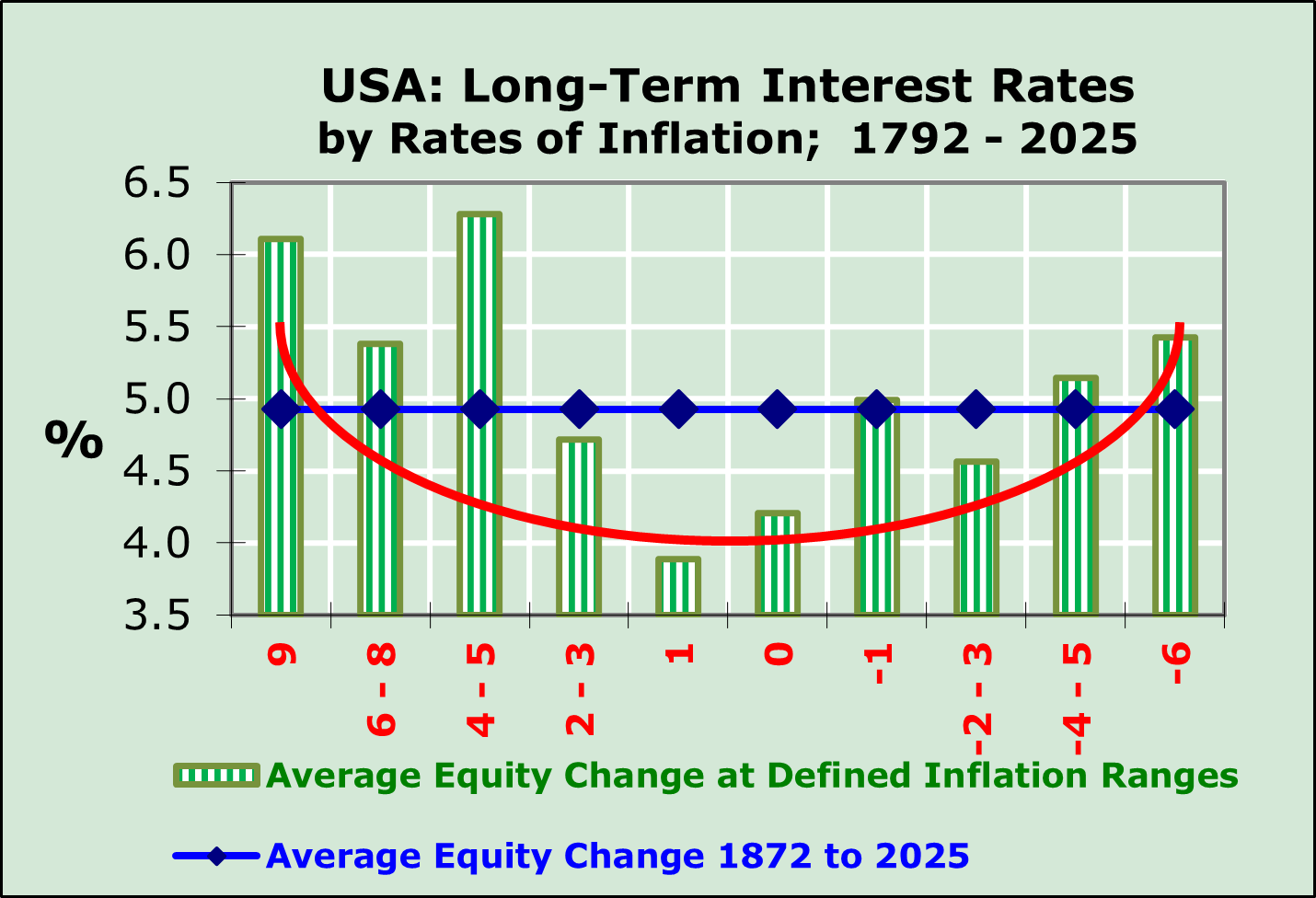
Our analysis of the long-term relationship between inflation and short- and long-term interest rates, as well as the DJIA stock index, has repeatedly piqued our curiosity. The reader might ask himself: why do we focus on the United States? Our answer is simple: long-term data availability. Ex-amining the following charts of short- and long-term U.S. interest rates, along with the corresponding inflation rates, we are faced with a specific puzzle that many analysts seem unwilling to acknowledge. The real ques-tion is: why are interest rates high both when inflation is strongly positive and when it is strongly negative? Most of the data and concept go back to the exchange I have had with an interesting colleague: S.C. Leuthold.
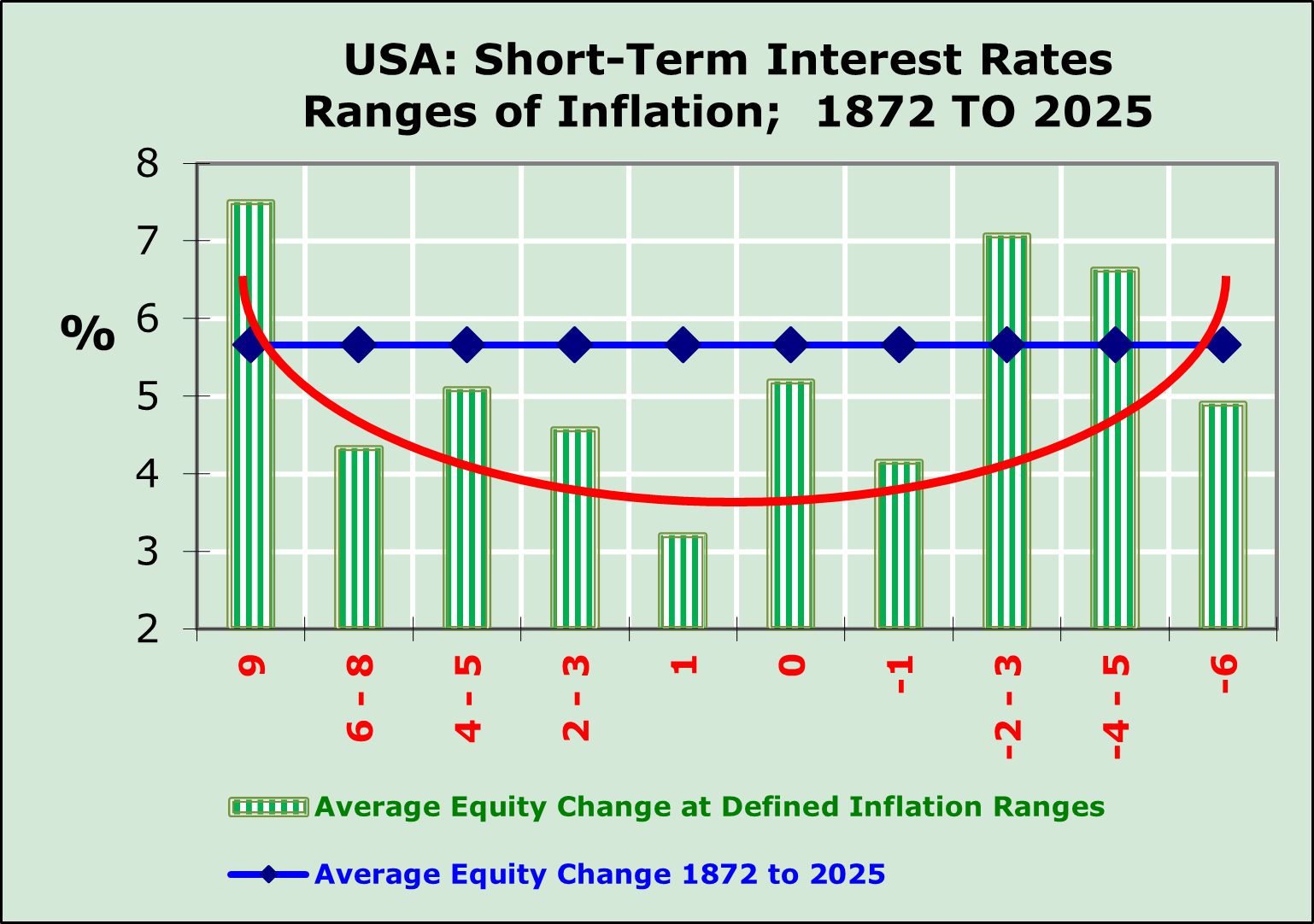
A surprising fact worth keeping in mind when evaluating the current public debate, on interest rate regulation is the historical observation that short-term interest rates have reached their lowest levels precisely during peri-ods when inflation fluctuated between +2% and (+/-5%).
Further, we ask ourselves: what do the charts implicate? Well, they show that the trend in long-term interest rates differs slightly from that of short-term rates, with one significant difference: interest rates are higher when inflation exceeds 5%. An additional specific aspect, we find difficult to assess, concerns the reason/s why interest rates are rising at both ends of the spectrum, as shown in the two charts of interest rates.
TREND – DETERMINISTIC ASPECTS
Of specific interest, at today’s crossing, are the effective repercussions of inflation, as well as of interest rates, on the equity market, here shown by the changes of the DJIA. The pertinent question we ask ourselves is, whether interest rate reworkings, as repeatedly demanded by prominent politicians, are the appropriate medicine to solve all current economic diffi-culties, concerning not only the DJIA performance.
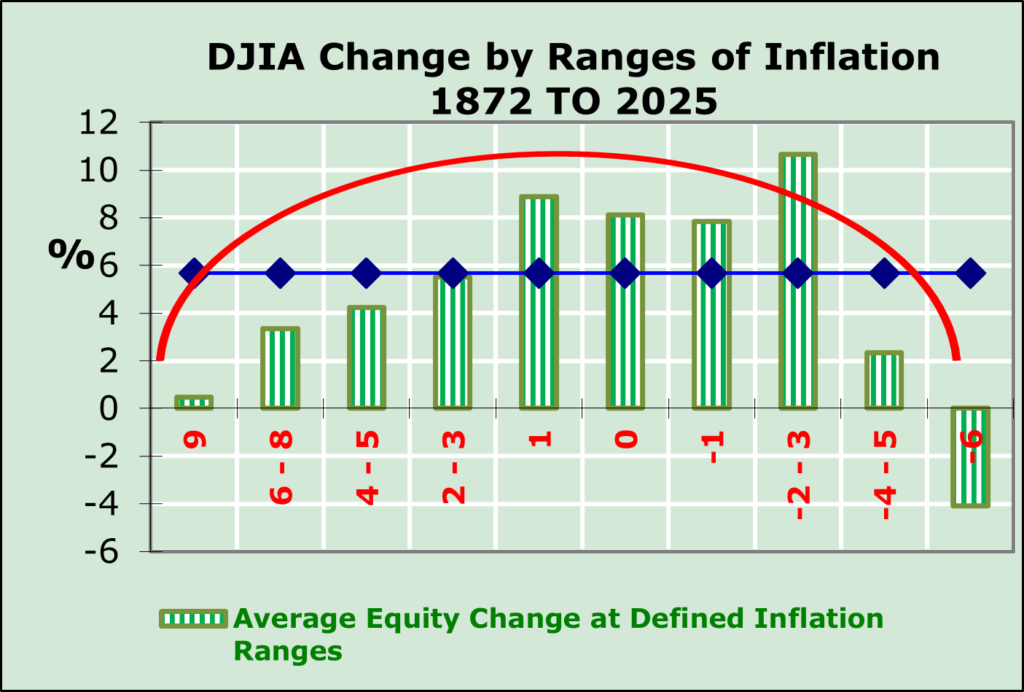
Comparing the developments of the DJIA with those of interest rates and inflation, we are confronted with a rather intricate puzzle, that few ana-lysts seem to take into account or choose to ignore – namely, the weak correlation between these factors.
ASSUMPTIONS FOR THE CURRENT INVESTMENT STRATEGY
We believe that the current outlook is truly challenging. To feel appropri-ately comfortable, let us make the following specific assumptions or hy-pothesis:
- The first hypothesis that comes to our mind, is the risk of a large-scale war, as recent developments in Ukraine and the Middle East have shown and continue to do so. We hope that the situation does not es-calate further.
- The second hypothesis concerns the inflationary impacts of rising crude oil prices. In this context, we are placing much greater emphasis on “significant volatility” while hoping that policymakers will take steps to improve the availability of raw materials, particularly of crude oil. We believe this scenario represents a plausible outcome, pushing inflation higher, regardless of an appropriate adjustment in monetary policy.
- A third hypothesis concerns the impacts on currencies. In our specific case, we anticipate a further appreciation of the Swiss franc. However, we may be facing a rather erratic performance.
Consequently, our current assessment remains primarily focused on ex-pectations, with a greater emphasis than usual on the domestic economy, the currency, and the stock market. From a strategic perspective, we an-ticipate further appreciation of the Swiss franc, a relatively stable EUR against the CHF, and further depreciation of the USD against both the CHF and the EUR.
SHORT-TERM EXPECTATIONS
We consider that the tariffs imposed by President Trump are key factors shaping the short- and medium-term outlook, as they undoubtedly amount to a tax increase. It is worth recalling that consumer spending has recently been the engine of economic activity – that is, the main driver of GDP growth – and this not only in the United States!
As implicitly revealed in the above shown charts, we consider the historical comparison as truly astonishing. We conclude that Trump’s opaque tax policy could continue to be an extremely important factor for economic ac-tivity and, at the same time, have a strong deterministic influence on the developments of inflation, and this not only for the US. We expect signifi-cant effects on a global scale.
Consequently, we expect – or worse – we fear a fairly deterministic indica-tion of a decline in economic activity, particularly regarding consumer and investment spending on a global scale.
SUMMA SUMMARUM
Readers may ask themselves why we make use of the “extremely” long-term comparison? What we implicitly try to do is to look at statistical facts which played a crucial, forcing role in the past and use them to avoid pos-sible future mistakes. The above shown developments e.g. of short-term interest rates tells us that, on an average band of inflation basis, the DJIA follows a similar growth path (coherent with rising negative resp. positive) rates of inflation.
The coming quarters are likely to see a slowdown in economic activity, particularly in the United States and, in due course, also on global mar-kets. From an investment perspective, these trend forecasts will undoubt-edly be significant. If we assess the situation correctly, they point to a clear HOME BIAS for both equities and currencies.
The promising approach we intend to follow at this time is known as DI-VERSIFICATION, which currently appears to be the primary indication of a “free lunch” at both the local and international levels.