Demand Pull vs. Supply Push

EMR May 2022

TAKING A CLOSER LOOK …

Dear Reader On the one hand, optimism reigns due to the economic growth of the leading nation, the United States, currently characterized by a consumer boom and near full employment. On the other hand, there is the language of the future, in which pessimism gives way to a spiral of geopolitical crises, a sharp rise in inflation and interest rate increases needed to combat inflation without hindering growth. Contained optimism in the United States, while in Europe and other industrialized economies pessimism prevails mostly due to Russian senseless ongoing aggression in the Ukraine.

In light of the recent rise in inflation and its impact on central bank interest rate policies, we are interested in what the best environment might be for equity markets. In this context, we will paraphrase causes, effects, and historical developments that should allow us to draw appropriate conclusions.

There are three promising approaches: the demand-pull, the supply-push and the most promising – the joint approach. Our deterministic assumption is that the overall political, social and economic environment remains marked by a high level of uncertainty. The world economy faces difficulties, beyond the war in Easter Europe, which concern the availability of resources both at the local level as well as internationally. The chart on the Dow Jones Index (DJIA), US Inflation and 3 months as well as 10-Y government bond yields since 1872 begs questions like what can be inferred form past developments by means of quantitative facts? From the chart – of yearly data – we might deduce the following:

  • Volatility is significantly higher for stock indices than for inflation and interest rates.
  • The longer-term ups and downs of short-term interest rates are more pronounced than for 10-year bond yields. Is it fair to assume that the period we are currently experiencing will resemble the post-World War II period?
  • The short-term “stability” of the inflation rate is indeed astonishing.
  • What is pronounced, however, is the dichotomy between the short-term information that emerges from the hard data in relation to the longer-term assessment. We consider this dichotomy an important aspect in the current forecast because it implies possible differences in outcomes when focusing on the demand-pull approach versus the supply-push inflation assessments.
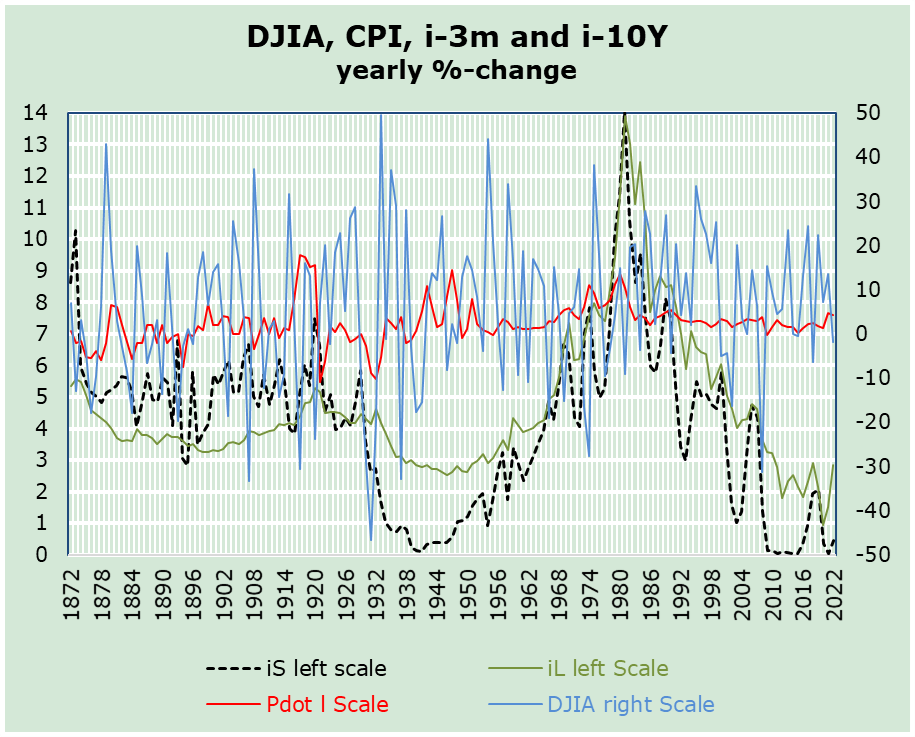
The longer-term ups and downs of short-term interest rates are more pronounced than for 10-year bond yields. Can we assume that the period we are facing currently will resemble the period post the Second World War?

Let’s ask ourselves which factors are currently more deterministic: cost push or demand-pull factors. The correct answer is that there are many explanations why prices are currently rising. In other words, we could argue that rising prices are not simply due to the expansion of money supply. Indeed, the following chart of the annual change in M2 money supply for Switzerland and the United States is interesting. The volatility of the Swiss data is much larger for the period between December 1985 and 2008 than in the U.S. for the period from December 1985 to the end of 2019. The two astonishing swings and corresponding corrections occurred in Switzerland from the end of 2008 to early 2011 and in the U.S. since the end of 2019. What are the factual implications of these developments? We believe that “other factors” were and are much more deterministic than money supply.
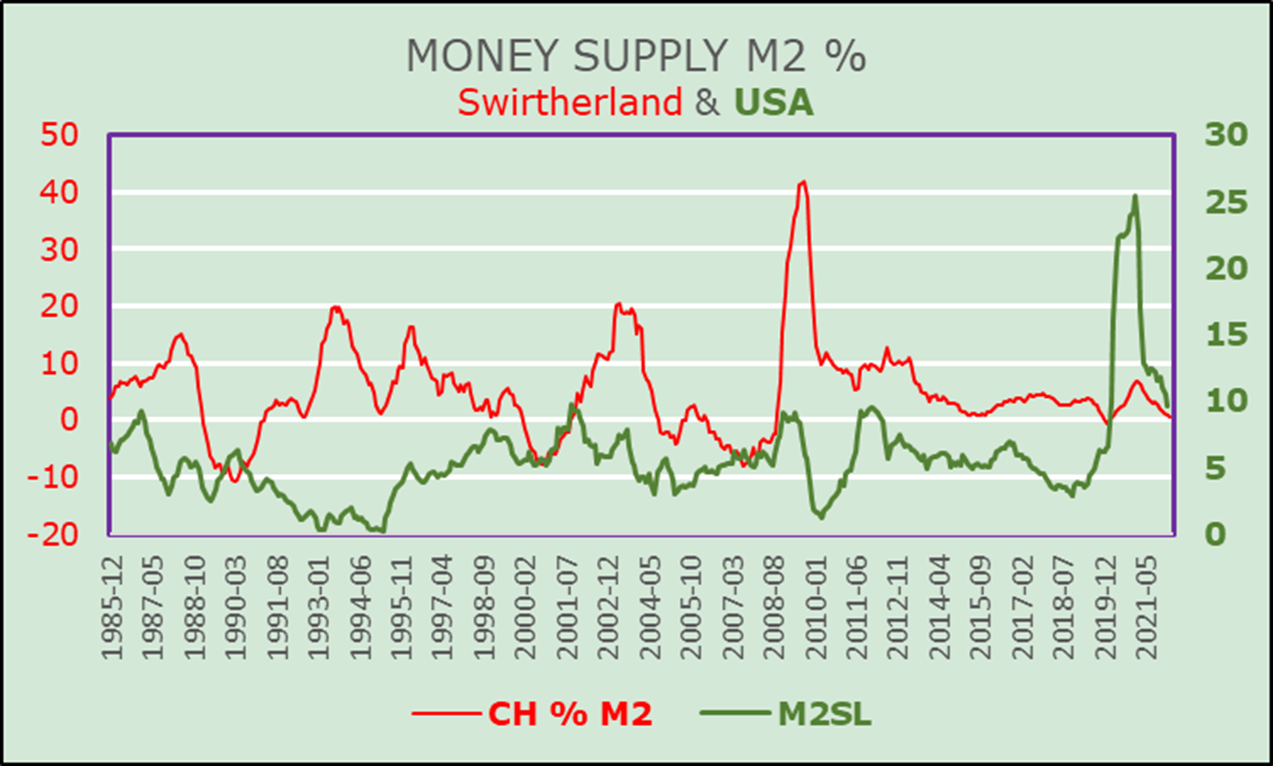
Sources: Swiss National Bank and fred.stlouisfed.org

DETERMINANTS: COST-PUSH AND DEMAND PULL

Here we do not subscribe to the widely expressed opinion that inflation is primarily due to monetary fine-tuning. No doubt the policy of Central Banks matter, and this not just as “moral suasion”. In the last decades we have encountered many reasons why prices rise and/or fall beyond movements of money supply. Currently we see that e.g., the price of crude oil increased due both as a consequence of strong supply and transportation restrictions as well as due to demand resurgence. The real question at this time refers more to supply restrictions than to demand revival. The environment is intrinsically determined by “politics” i.e., the war. The cost of labor, another source of price volatility is due to the ability of producers to arbitrarily compensate rising prices. At this juncture we find it highly difficult to quantify the interplay of “Cost-push and Demand-pull” factors, beyond and or depending of the expected or feared monetary actions. As we all known in almost all periods of history inflation has been a combination of several factors. The current specificity is due to synchronous worldwide repercussions, on the real economy as well as prices, interest rates and currencies. It must be factored in that the governmental “printing press” of recent quarters and years – in order to combat particularly the COVID-19 pandemic – must now be controlled, hopefully by means of subtle interest rate increases.

FRAMEWORK CONSIDERATIONS

Once again, we would like to stress that we are unable to determine when and how the Russian invasion and dismemberment of Ukraine will end. In spite of the unacceptable human tragedy, we should seriously consider the implications not only on the energy front but also on the food front, mainly for Europe and the whole world. Although the media mainly focus on inflation “tout court”, i.e. without mentioning the specific causes, we believe that these are expected to have a decisive impact on the allocation process.

At this stage we do not see any specific isolated factors that could determine the course of inflation. We are thinking of bad weather or new epidemics. Inflation due to the war will continue to play an important role, especially – and we hope – only in the short term. Food prices must be taken into consideration at this point. They will continue to suffer as a function of the Russian invasion of Ukraine. The offer speaks of a possible increase in food prices in the medium to long term. Another reason for inflation will be the recovery of global economic activity. Inflation of the economic cycle should – at this juncture – only have a short-term deterministic value.

FINDINGS FOR INVESTORS

The recent ups and downs on a global scale remain difficult to permit a clear-cut formulation of a promising investment approach. In other words, the environment remains elusive. Therefore, we suggest the following approach. It is a known fact that almost all major wars have been a major cause of inflation. Should we expect that this time around it will be much different? Industrial production is not expected to yield much support to economic growth. Why? Because there are additional reasons like the Covid-19 pandemic and the national and international transportation of raw materials and intermediate goods and services.

A first consequence speaks of short-term trading. This approach suggests that daily, weekly and monthly volatility is expected to remain fashionable.

Second, sectoral rotation should not be underestimated, especially in the short to medium term. From a historical perspective, there seems to be no doubt that the current setting requires an adjustment of the profit or loss potential in constant currency.

Third, inflation at levels over 3 to 4%, together with the impending need to tighten the monetary environment to prevent inflation to increase even further, must be taken as an indicator that the equity markets ought not to be an inflation hedge instrument.

Fourth, we continue to believe that, at least over the short-to-medium term, Swiss investors should focus preponderantly on the domestic currency.

At this stage, given the recent markets´ correction we believe that investors should remain more focused on equities than on fixed income instruments.

Comments are welcome.

Facebooktwitterlinkedinmail

Follow the Money

EMR April 2022

In the Fokus

Dear Reader

Die derzeitigen geopolitischen Umwälzungen verändern die wirtschaftlichen Aussichten und deuten, zusammen mit der durch Preisschocks verursachten Stagflation, auf eine weithin befürchtete Konjunkturabschwächung hin. Die Entwicklung der amerikanischen und europäischen Aktienindizes, der Anstieg des Goldpreises und die rasante Verteuerung von Rohöl und Gütern deuten darauf hin, dass die Preise nicht nur kurzfristig steigen werden.

The current geopolitical upheaval is changing the economic outlook and together with stagflation, caused by price shocks, points to a widely feared economic slowdown. The developments in the American and European stock indices, the increase in the price of gold and the rapid increase in the price of crude oil and goods indicate that prices will rise not only short-term.

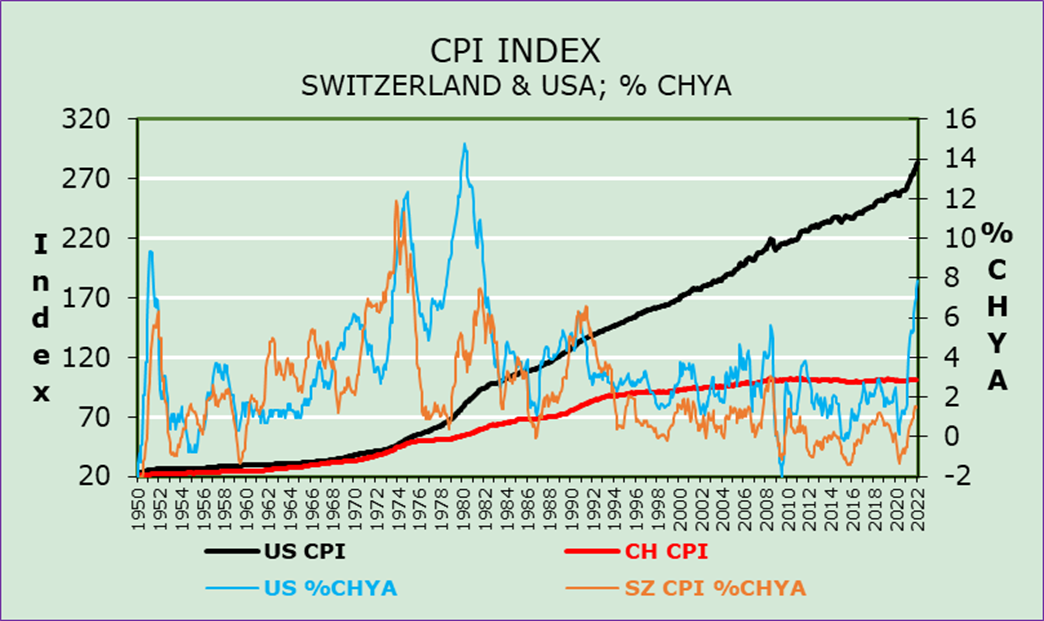
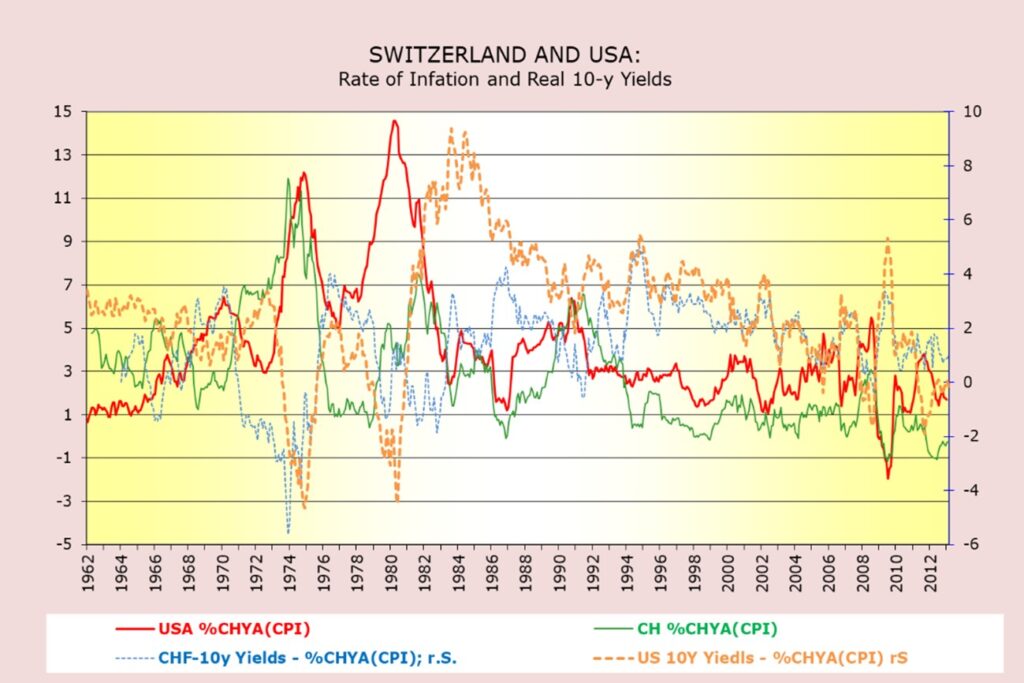
What can we learn from history? If we look to the stock market indices from February 23 to April 1, 2022 the strongest negative impact on equities relates to the German, British and Swiss indices, while the price of gold increased by 4%. Worthwhile recalling are the past swings. Swiss inflation rose first in the early 1970`s, while US inflation peaked in the early 1980`s. So far in 2022 the rate of growth of the US CPI is once again quickly on the way up.

Over the short-to-medium term, further price shocks can be expected as a consequence of the Russian invasion in the Ukraine. Prices for commodities (e.g., oil and gas) and for food (e.g., wheat, corn, and soybeans) will continue to increase. For forecasters, it would indeed be rewarding to compare and analyze the assumed similar downward corrections of consumer prices of 1950-51, 1975 (following the oil crisis) and especially in the early 1980`s (following the energy crisis) and more recently (following the financial crisis of 2007-2009)! See chart on CPI Index.

The effects of the recent and still ongoing Covid-19 pandemic make it considerably more difficult to quantify the return of price advances to more normal levels. The impact of international trade and various economic policy measures on prices should not be neglected either. The current conflict on the EU’s border is unlikely to remain attractive to consumers in Western countries, especially as wage increases could be significantly delayed. Moreover, it is very difficult to quantify the whereabouts over time of supply chains.

International comparisons are currently further complicated by the split at the currency level, with the surprisingly rapid rush to the traditional safety currencies: the Swiss franc and the US dollar. The consequences of the inhumane tragedy cannot be underestimated. There will be repercussions on both sides of the Atlantic regarding inflation, economic growth and interest rates, and thus for monetary policy. It is worthwhile recalling that on March 16, 2022, the Fed decided to raise the federal funds rate by 0.25 basis point. Chairman Powell indicated that the Fed plans six more rate hikes in 2022. It can therefore be assumed that the European and Japanese monetary authorities will sooner or later follow the U.S. example.

The chart points to two astonishing developments:
The gap between the Swiss and the US Indexes since 1975 is astounding.
The ups and downs of the Swiss inflation rate precedes those of the U.S. inflation!

International currency sanctions are causing tensions. The intention is to constrain the Russian economy and the immense wealth of the Russian oligarchs. However, it is clear that the measures will not only hit the aggressors, but also the investment policies of the Western world. The power of the financial world, hampered by the availability of hard data, clearly points to a financial blockade.

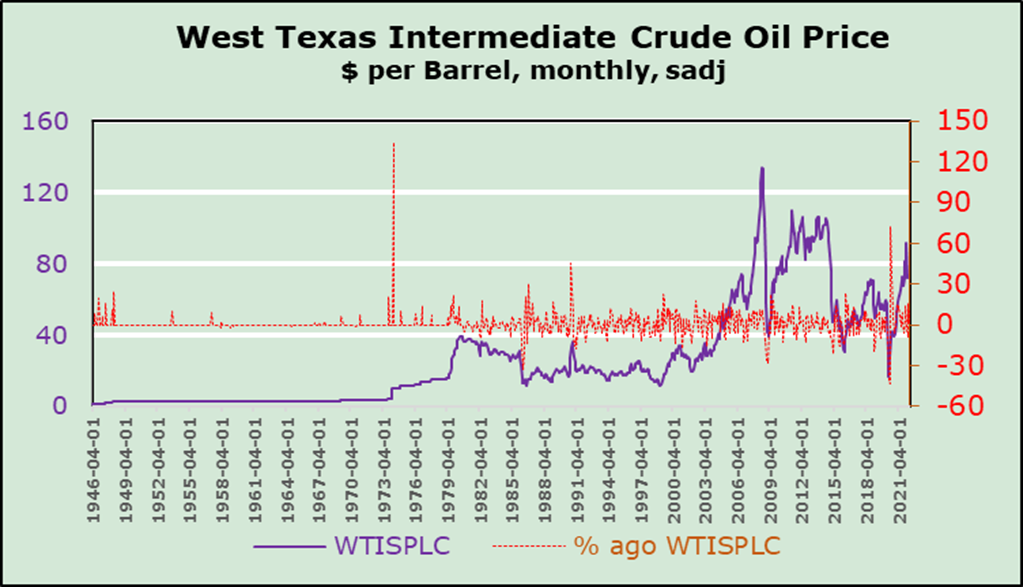
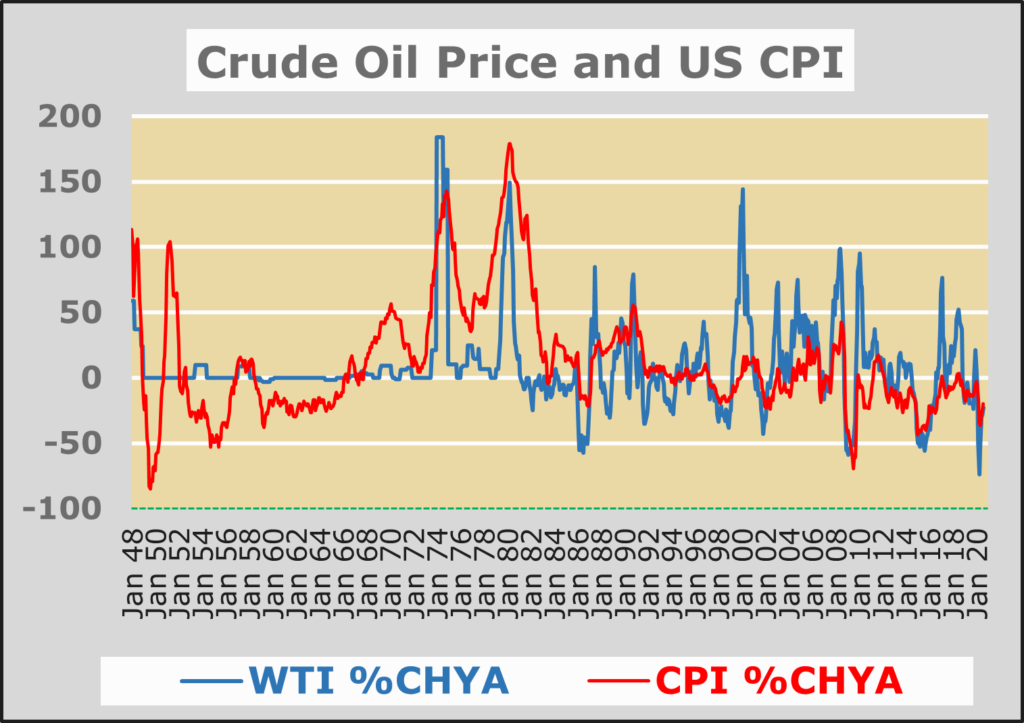
More and more politicians, central bankers, economists and the general public are pointing to rising inflation and inflationary pressures. At this stage, the chart of spot crude oil prices is instructive, as shown by the West Texas Intermediate (WTI) price. Will these developments lead to rising and sustained inflation? The chat indicates a renewed rapid rise in prices. The question that arises is: will the price of crude oil last as long as it did in the period after 2000?

The chart points to a renewed rapid rise in prices. The chart bets the question: How high and how long will the price of crude oil rise, resembling may be the period after 2000?

At this stage, we are much more concerned about the trend reversal of globalization and its impact on businesses and government policies. Recall that the recent rise in inflation has been and will continue to be caused primarily by increasing commodity prices and bottlenecks in industrial supply chains at the global level.

We expect that it will take some time before the impact of the continuing Russian ag-gression can be clearly assessed. The longer it lasts, the more it will undoubtedly con-tribute to raising the prices of energy and all other consumer goods, and even more so of capital goods, especially in the area of international trade. It would then be assumed that the economic situation would have consequences for the free world. It would lead to the reversal of globalization. Consumers, entrepreneurs and governments would suffer, also depending on the length of the financial and economic embargoes. It is likely that it would be difficult and expensive to repatriate some of the production. A difficult ques-tion, in the context of rising inflation, concerns the ability to bear the corresponding costs of “repatriating” production without further fueling protectionism.

Framework Considerations

At this point, it is worth remembering that forecasters face a particularly difficult quantification exercise given specific implications for the supply and demand sides of the equation. One can be more pessimistic or more optimistic depending on the weight given to the supply or demand side. We prefer to focus on the interdependencies and remain somewhat more constructive than the most vocal forecasters. The fact is, that the invasion of the Ukraine and the resulting liquidity tightening will continue to support inflation for some time. The associated liquidity squeeze, combined with the rise in commodity prices, suggests a slowdown in economic activity and rising interest rates. In this circumstance we assume that the most deterministic assumption concerns the expected reversal toward significantly higher domestic output. If it actually occurs, this would imply higher production costs at least in the short-to-medium term, thus arguing for persistently higher inflation rates compared with earlier comparable periods. Countries with significantly higher domestic production stand to benefit.

The second deterministic assumption relates to the efficiency and international independence of the financial environment. The U.S., with its much stronger domestic orientation, should benefit compared to, for example, Europe and Japan. Switzerland could “benefit” from a higher Swiss franc and rather sustained liquidity compared to the EUR and the pound sterling.

The third deterministic assumption relates to the attractiveness of the respective currencies. A concrete example is the impact of the trade deficit on the YEN/USD exchange rate since the start of the Russian invasion of Ukraine on February 23, 2022. The depreciation on April 1, 2022 amounts to 6.14%. These developments have and will continue to have an impact on the country allocation process. In other words, in a phase of high and prolonged volatility, be it in relation to economic growth, inflationary trends and the flight of capital in search of safety, as well as specific difficulties at sector and/or company level, require focused attention to a much more selective approach than the one used in recent times.

Findings for Investors

Given the rather unpredictable prospects of an early end of the Russian invasion of the Ukraine, we tend to take the following investment approach:

For the Swiss franc investor, an above-average exposure to the domestic market and currency looks promising indeed. International diversification should focus on those economies that are able and willing to increase domestic production, especially of intermediate goods and services.

Given the higher cost of money and below-inflation bond yields, investors should continue to focus on equities rather than fixed-income securities. Our view remains influenced by the statement of Fed Chairman Powell, of March 16, 2022, regarding six possible further interest rate hikes.

Comments are welcome.
Facebooktwitterlinkedinmail

Review 2021

EMR December 2021

Dear Reader

In this EMR, we take a look back at our forecasts and assumptions for 2021, and find that our preference for equities has been rewarded by an acceptable, differential rate of earnings growth. Taking the respective themes into account, we come to the following conclusions:

  1. The focus has been on Volatility, Virus and Vaccine and respective determinism on the asset allocation.
  2. Once again, we found that nothing is more deterministic than cyclical comparisons.
  3. We examined the repercussions on economic activity, inflation and interest rates.
  4. We clearly pointed out the various types of distortions, and
  5. We found that great upheavals create major opportunities.

ASSESSMENT 1: Yearly outperformance.

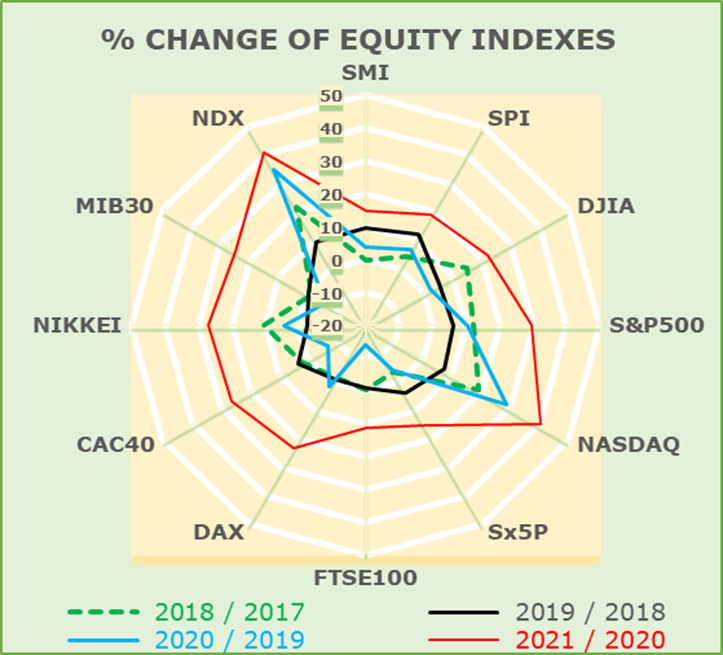
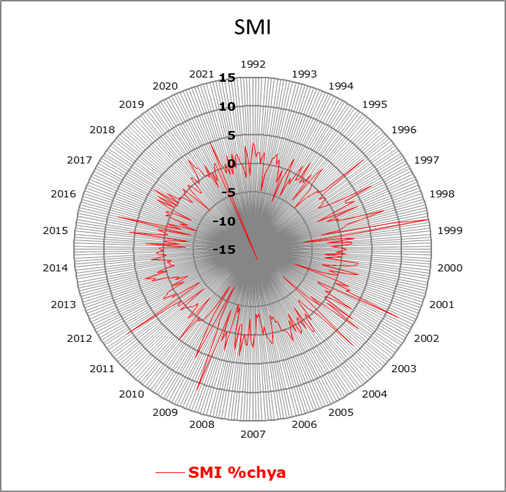
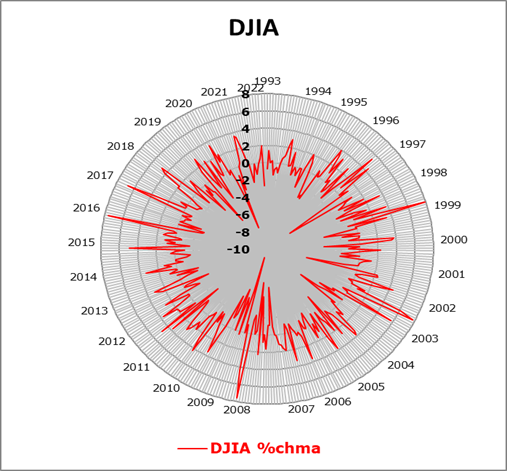
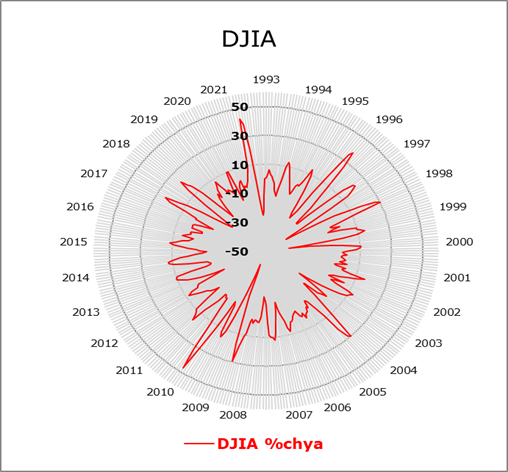
The following charts and table, based on the daily closing prices of selected stock indices, show the respective annual changes. It can clearly be seen that the stock indices performed better in 2021 than in the three previous years. The disparities can be summarized as follows:

One, there are sizeable differences between the indexes on a country-by-country basis, as well as between the technological content of the US indexes. The outperformance (as we repeatedly commented in various EMR`s) of the indexes heavy-weighted in technology is astonishing indeed. These developments underline the importance of sectorial selection.

Two, “simili modo”, we might argue that 10-year bond yields confirm our assessments to underweight this investment category and to take currency expectations resp. corrections seriously into consideration. Looking back to the singly 2021 EMR´s we find confirmation of our positive assessment of equities vs. bonds and money market investments. The returns differences, excluding taxes and other costs, clearly confirm the recent attractiveness of equities over bonds, as shown in the following table and charts. The longer-term analysis of 10-year bond yields (see chart below) is telling indeed.

What does the chart tell us? Let`s remember that pessimism was widespread in 2021. Yet, we did not adopt the widespread negative assessment. The average performance of 2021 over 2020 has been significantly better than in the three years before. In the following we summarize our reporting as in the various EMR´s of 2021.

ASSESSMENT 2: The three V`s: Volatility, Virus and Vaccine.

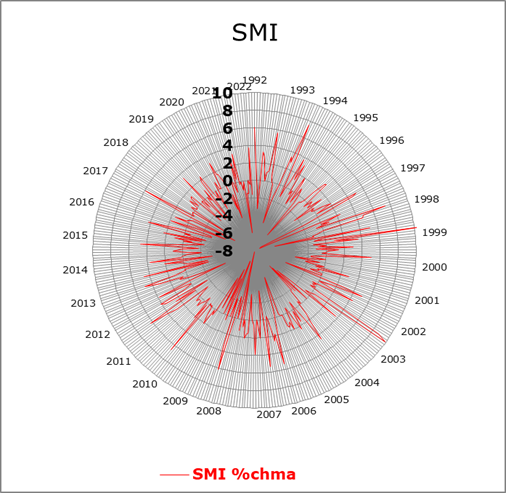
At no time we took daily Volatility, the Virus and/or the Vaccine as trend setting. In view of the outperformance of equities versus fixed-income securities and money market instruments, we allow ourselves to solely assess the fate of the Swiss and U.S. equity markets. The following charts show the respective average monthly rates of change, revealing quite different patterns. Surprisingly for some, we did not find confirmation of the well-known statement: “The trend is your friend”. The charts simply speak of the difficulties while defining the own expectations. We deem ourselves lucky, in focusing on the right data, as implicitly visible in the differential developments of the monthly vs. the yearly rates of change.

ASSESSMENT 3: Deterministic is the cyclical comparison.

Usually, the daily closing values (of the stock indices) are shown. From the respective growth rates, one can in most cases deduce in which market one should be over- or under-invested. The developments of the SMI and the DJIA shown in the charts above are, as already mentioned, quite difficult to interpret. Nevertheless, one can deduce where the short-term trend might be headed as compared to the longer-term trend. What is easier to estimate is the time it might take for the index to return to its “normal” growth path.

ASSESSMENT 4: repercussions on economic activity, inflation and interest rates.

We all know, that this is an exercise that can go either way, i.e., as a driver of the economy or as an impediment. Depending on the context, there are a variety of possible interpretations. In other words: forecasting the future is a difficult exercise. It requires the most appropriate selection of the appropriate factors shaping the future environment. Even the knowledge of previous comparative periods is not always suitable as desired. The environment may appear to be quite similar, although important determinants remain indeterminable. Currently, these difficulties are evident in expectations, depending on the hoped-for end of the Covid 19 pandemic. Moreover, it can be argued that technological innovation, can and should provide much needed clarity. At present, many analysts remain rather skeptical about these deterministic factors of the fate of consumer attitudes. They hardly simplify entrepreneurial decision making regarding the much-needed adjustment of production lines.

ASSESSMENT 5: distortions.

TYPES OF DISTORTIONS: In the July EMR we focused on the marginal rate of transformation in production (TTP) as well as on marginal rate of substitution in consumption (TTC) and also, on the foreign terms of trade (FTT). We argued that these three factors were, are and will continue to be deterministic for some time. The transformation of production lines influences and distorts consumption goods to be exchanged in the world markets. Hardly a day goes by without a comment on one of these factors. Just think of the influence of the various Covid regulations as determinant of production and consumption. Specific repercussions are then visible in due time in the quarterly statistics of economic activity (GDP and components). At this juncture any quantification looks rather problematic and uncertain. As an expedient many analysts focus on prices, i.e. inflation as a promising determinant of future developments.

ASSESSMENT 6: great upheavals create major opportunities.

As known, in the past great upheavals did create major opportunities. As an example, we point to the growth revival following the great recession of 2007 – 2009, for Switzerland and the USA. This, in our opinion, could definitely be something to look into in the 2022 EMR`s, given vivid hopes of a U-Turn in the Pandemic, which in due time could lead to a sizeable economic recovery on a worldwide scale. We are aware of the fact that currently it is rather difficult to be optimistic, given the attitude of Central Banks, particularly of the US Federal Reserve, to start reducing the overall liquidity in order to contain feared inflation pressures. Fears of inflation are, a function of “politically induced” strong consumer`s support, and also to prevent further increases in the rate of inflation. According to Chairman Powell, the FED is no longer primarily fixated on encouraging a further recovery in the long-running labor market, but primarily on getting the potential for inflation under control. The risks of price increases have also to do with the strong demand for goods and services and also with the hope of getting the supply bottlenecks under control.

MERRY CHRISTMAS and a HAPPY NEW YEAR 2022.

Comments are welcome.
Facebooktwitterlinkedinmail

Rythm of History

EMR November 2021

Main Lines of Change

Dear Reader

Studying the literature on economic change, while focusing on the post-World War I period, is very instructive, especially as a guide to the current turbulent environment. The available forecasts reveal major economic and social imbalances. We consider them quite significant, especially in the context of current uncertain developments.

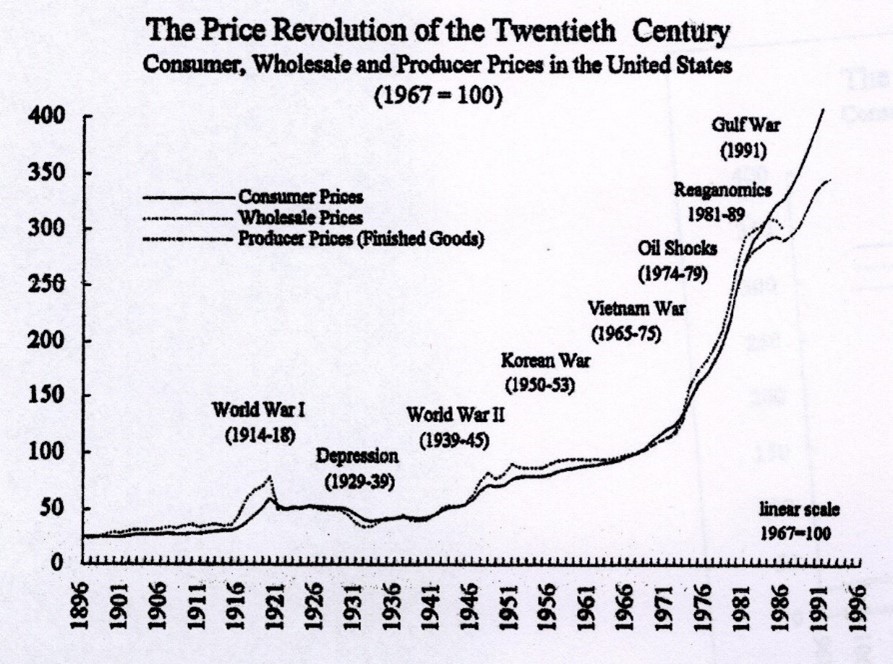
Extrapolating the graph of the U.S. Consumer Price Index to September 2021 would result in a near doubling; the index would then rise to over 800! This further increase goes hand in hand with the various shocks. The sharp increases in the inflation rate began, as shown in the graph, in the late 1960s. What are the reasons for these developments?

Deterministic Facts

The above chart portrays two very disparate developments. On the one hand we find a rather volatile but smooth increase from 1896 to the late 1960, and on the other hand a dramatic, almost linear increase into 1996. In this EMR we will concentrate our attention to the second phase, i.e., the period since 1967.

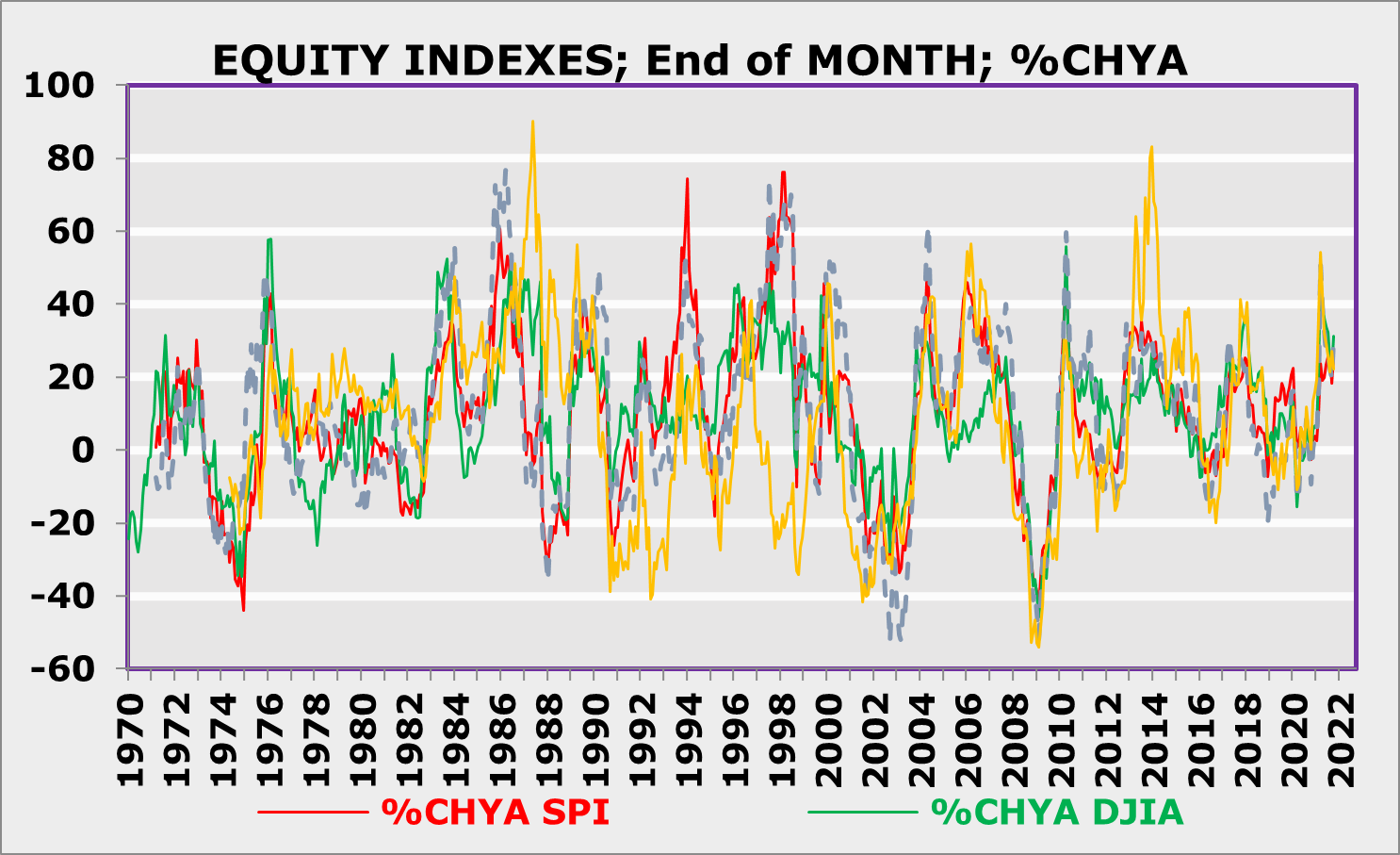
Before analyzing the developments of real GDP, we would like to show the development of the stock indices since 1970. The corresponding chart (below) shows substantial fluctuations in the annual averages. The chart is hardly exactly quantifiable, is it?

In our analysis of the economic performance, we focus primarily on the development of real GDP in Switzerland and the United States. At this point, we wonder what is the connection between the fluctuations of real GDP and the stock indices, as shown in the above graph.

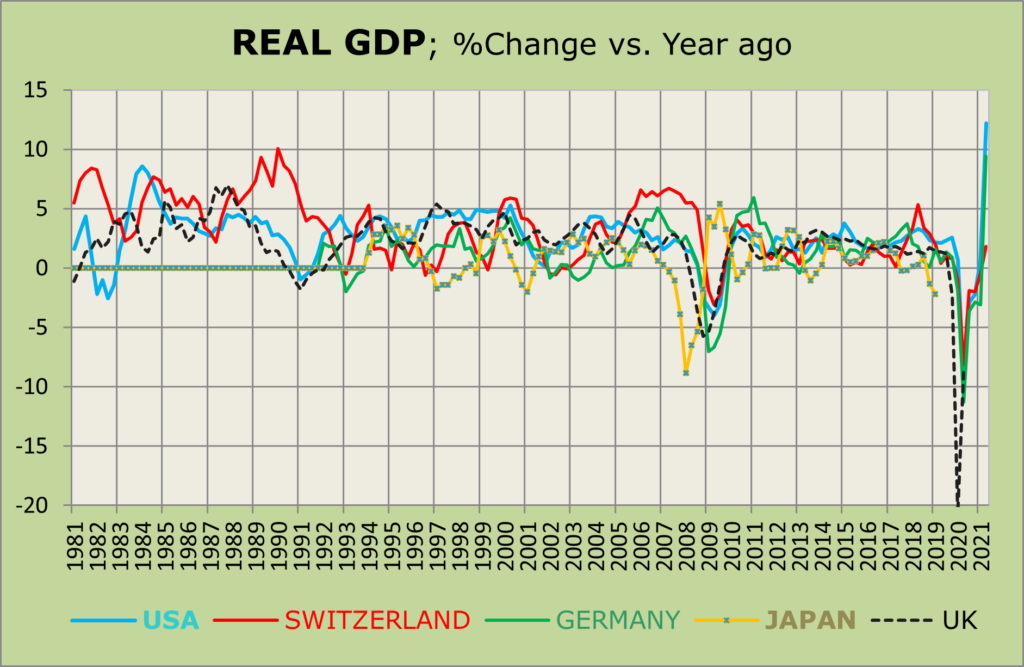
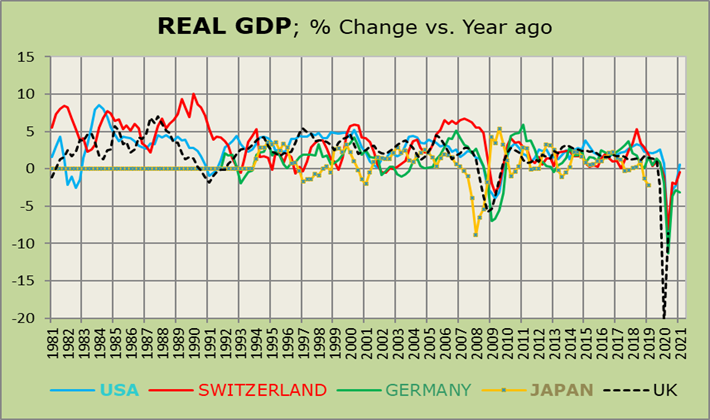
The available real GDP data for the five industrialized countries clearly show that there has never been an equivalent correction since the early 1980s, with the exception of the period from 2008 to early 2010! The chart shows that the Swiss economy reacted with a “substantial” lag to the downward corrections of real GDP in the U.S., Germany and the U.K. Developments in Japan are much more pronounced for the period 2002-2010.

The diagram above indicates two very different developments. On the one hand, there was a fluctuating but steady increase from 1896 to the end of 1960, on the other hand, a dramatic, almost linear increase until 2021.

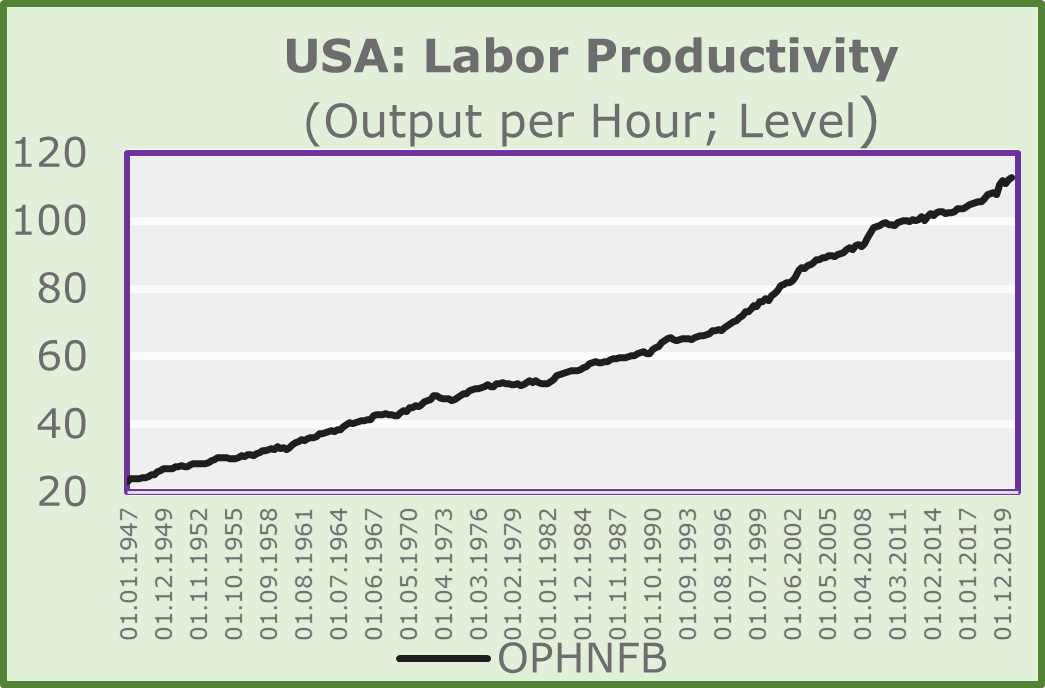
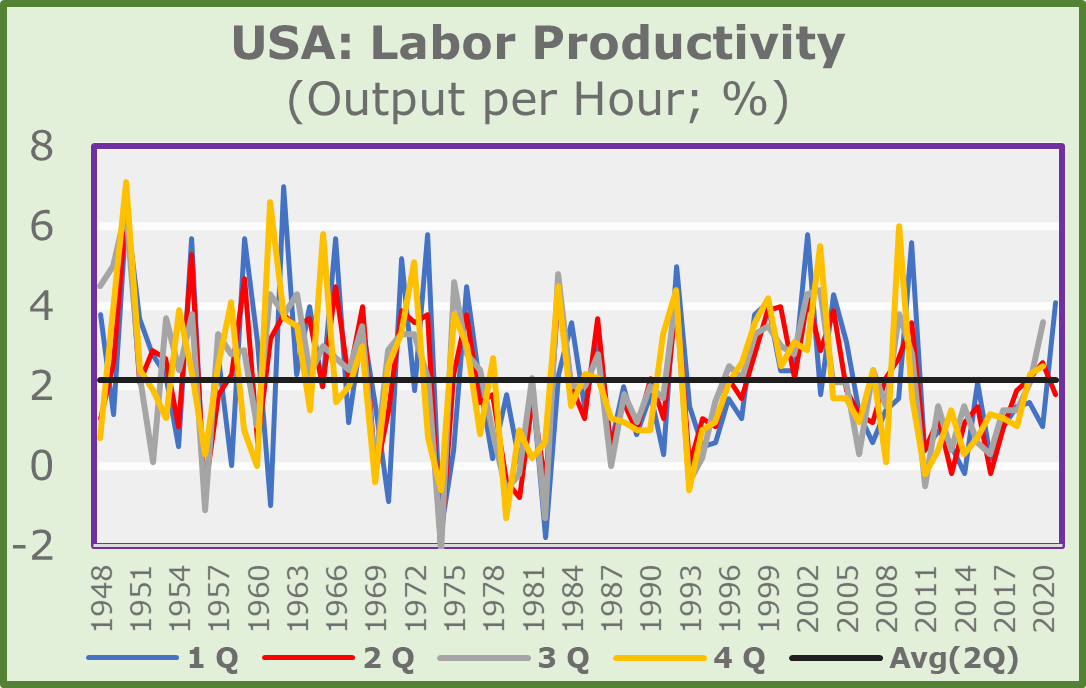
One of the main reasons for this can be derived from productivity developments. For the sake of simplicity, we again limit our analysis to productivity developments in the USA. We assume that they are also valid for Switzerland and other industrialized countries.

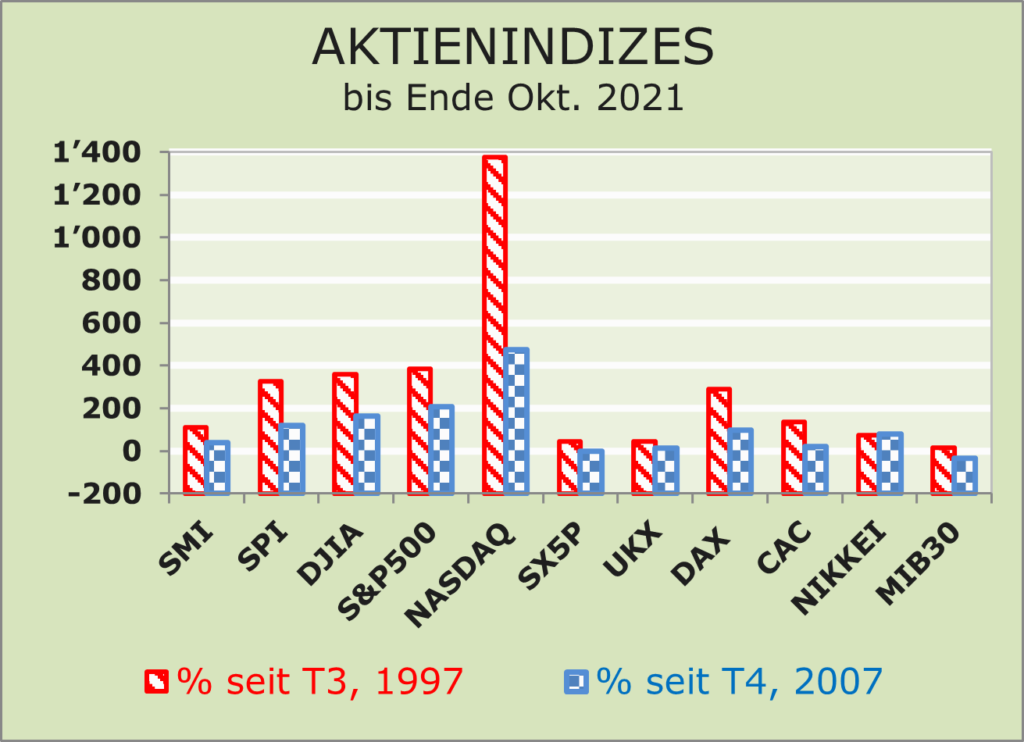
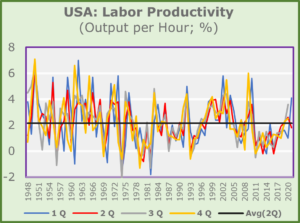
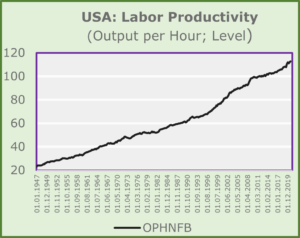
The level and quarterly rate of output per hour, as published by the U.S. Bureau of Economic Analysis, are much less volatile than real GDP, this measured by quarterly rates of change. Why this is so is the real question. Could it be that productivity is much more responsive to inflation – and especially to inflation expectations – than to economic activity? Long-term analysis, however, seems to suggest that productivity responds much more quickly to overall economic activity than to inflation! In recent years, productivity has adjusted strongly to sectoral changes. These developments were not so readily apparent at the macroeconomic level (real GDP). This is certainly due to the fact that companies have adjusted their production lines – and will continue to do so – much faster than reflected in macroeconomic data. New production lines require different inputs, both on a material and human basis. This has happened – and continues to happen – at both the firm and sectoral levels. In case you have a different opinion, let me draw your attention to recent developments on the stock price front. The differences between the various indices shown and the Nasdaq 100 Index speak volumes, don’t they?

The chart shows dramatic shifts between the two time periods, as well as between the various indexes and the technology-focused Nasdaq. Could it be that the Covid-19 pandemic would trigger a similar shift both between the different indices and countries?

We all know that certain sectors disappear over time while others emerge. Just think of the changes in the automotive industry in the past compared to the expectations of chip-controlled automotive production of today and especially tomorrow.

How to Benefit From Productivity Changes

Can you benefit from the expected/feared productivity changes? A somewhat difficult way to answer this very deterministic question implies that one should prefer stocks that have shown the best productivity performance in the past and have responded coherently to significant productivity changes, i.e. stocks of companies that recognize and quickly react to signs of a productivity turnaround?

If this approach does not satisfy everyone, there is another way, which is to reduce exposure to companies and industries with the worst productivity histories, either in the short term or, more importantly, in the long term. Our contextual argument is to take seriously the fact that turnarounds are sometimes quite dramatic, especially for companies or industries with high debt burdens. A dramatic productivity turnaround, such as the one we are currently experiencing, is often accompanied by dilutive financing and a high debt burden. In such a case, the substantive argument is “buy the problem solvers” or, to paraphrase a well-known slogan, “invest in the doctors, not the patients.”

Conclusions for Investors

Our conclusions should be seen as a specific consequence of an extraordinary shift toward technological innovation and away from the traditional “output per hour worked.” We should take the impact of new technologies ever more seriously.

This also means that even if inflation fluctuates by 2% (which is considered historically low), equities would continue to perform better than fixed-income securities and money market instruments.

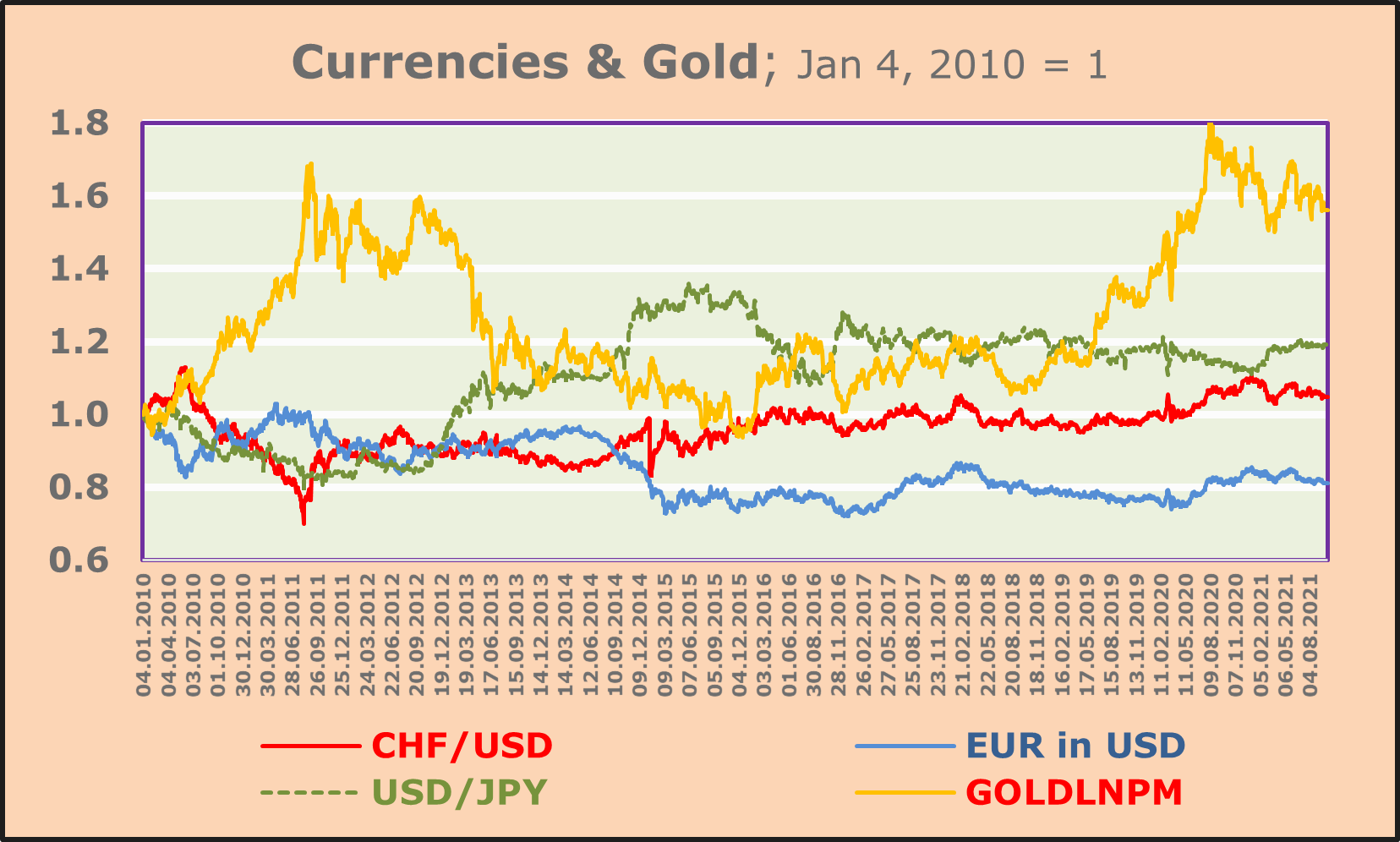
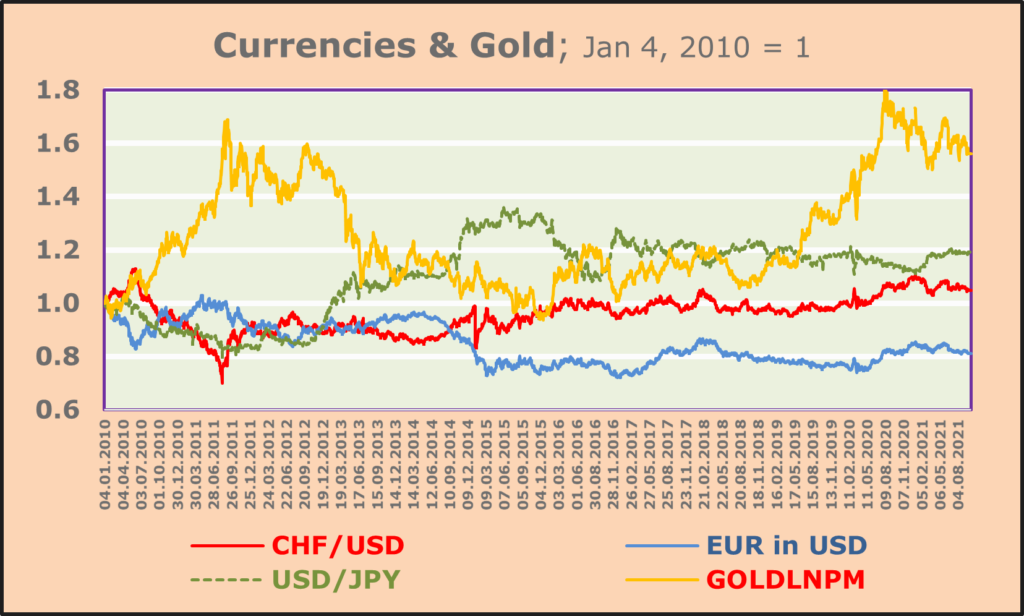
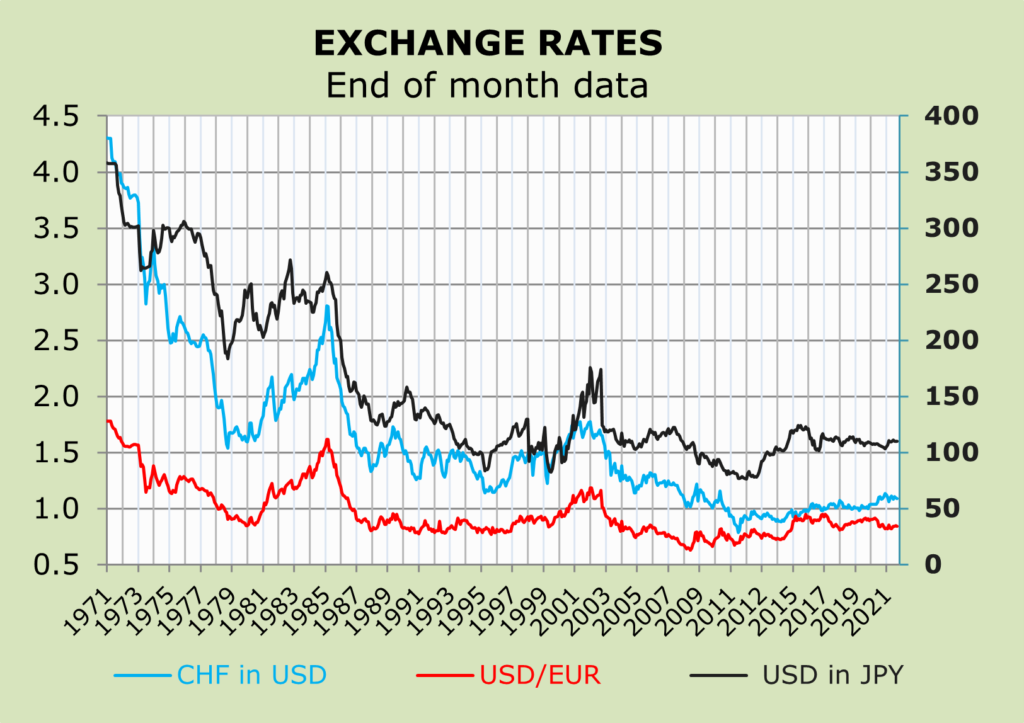
As a result, the USD is expected to rise against the EUR, the YEN and the GBP. The fact that the CHF, EUR and JPY have recently fluctuated in quite narrow ranges against the USD must be taken into account, also because the dark clouds in the currency sky do not bode well.

Any suggestion is highly welcome.

Facebooktwitterlinkedinmail

Required Homework

EMR October 2021

Great Upheavals Create Major Investment Opportunities

Dear Reader

The investment outlook is rather bleak, driven mostly – but not solely – by lagging productivity, fears of rising inflation, and high and rising governmental indebtedness, as well “unwarranted” fears of an impending equity market correction.

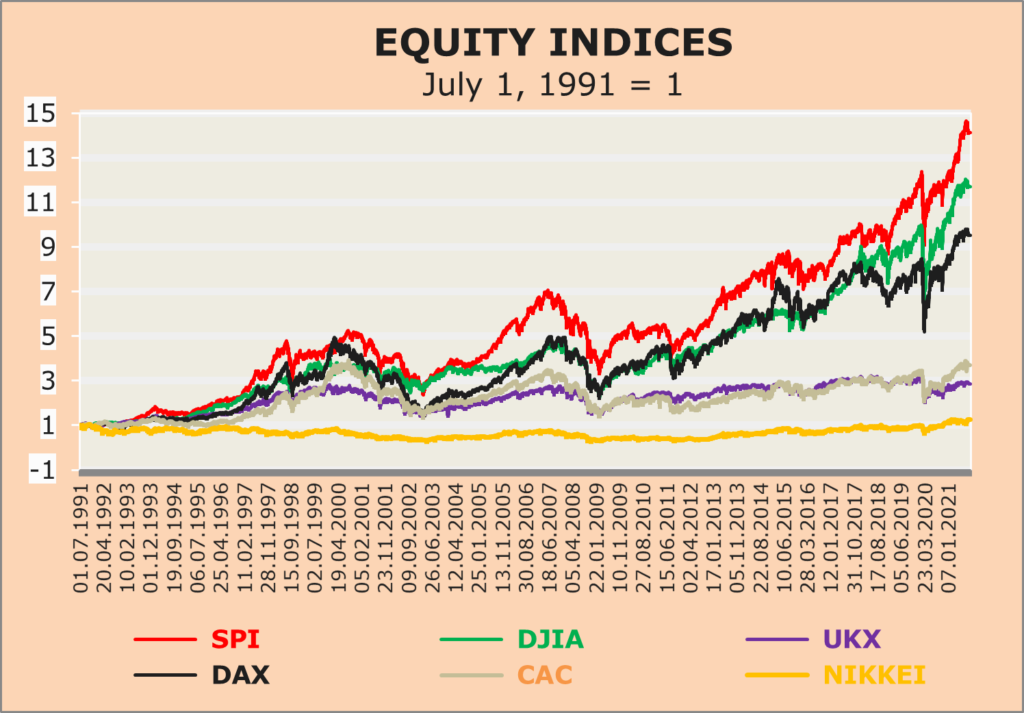
What does the chart on long-term indexed equity indices suggest?

Poorest performance = NIKKEI
Mediocre performance = UKX and CAC
and
Best performance = SPI, DAX & DJIA.
Does the chart imply something about productivity and/or on something else?

Why the Focus on Productivity?

Over the years, we have learned that the best-performing companies (represented here by the respective stock index) in some sense can be quantified by the interaction of productivity, inflation growth and currency performance. Recently, however, productivity gains have been increasingly hampered by governments’ deficit spending. It is a fact that in the past those sectors of the economy that have been able to improve their productivity while providing “new” equipment (through innovation and technological progress) have experienced a significant boom and have prospered significantly. What role have currencies played is an interesting question. In this sense, we are not surprised that the SPI, the DJIA and the DAX perform so differently compared to the NIKKEI, the UKX and the CAC index. We do assume that equity markets are not an inflation hedging instrument but a play-ground for currency specialists! It can be deduced from the chart on real GDP that the problems dominating the current technological progress point to a difficult identification exercise of the companies and industries with the highest potential capabilities to solve the productivity problems, inflation expectations and currency reactions. We thus continue to focus on the innovative spirit of each company and/or sector of the economy. The focus must thus be on the power to innovate, to counterbalance the power to tax = the power to destroy.

The available real GDP data for the five industrialized nations clearly show us that there has never been a similar correction since the early 1980s, with the exception of the period from 2008 to early 2010!

The chart shows that the Swiss economic activity reacted with a “substantial” lag to the downward revisions of real GDP in the USA, Germany and the UK. The development in Japan is much more pronounced for the recession period 2007-2010.

The level and quarterly rate of output per hour, as published by the U.S. Bureau of Economic Analysis, are much less volatile than real GDP, relative to quarterly rates of change. Why this is so is the real question. Could it be that short-term productivity is much more sensitive to inflation – and, in particular, inflation expectations – than to general economic activity? Long-term analysis suggests that productivity responds much more quickly to general activity. In recent years, there has been a strong adjustment of productivity to the sectoral environment, which has not always been immediately visible in the macroeconomic data (real GDP). This is certainly due to the fact that companies have had – and will continue to have – new products and appropriate capabilities to increase productivity, both at the sectoral and company level. We all know that certain sectors fade over time while others emerge – just think of the changes in the automotive industry in the past, compared to the expectations of chip-driven automotive production.

How to Benefit From Productivity Changes

We take the liberty of asking the reader how he/she can benefit from the expected/feared productivity changes?

A rather arrogant way to start answering this very tricky question implies that one should preferentially invest in stocks that have historically shown the best productivity gains and a coherent response to significant productivity changes, i.e. stocks of companies that recognize and quickly respond to signs of a productivity turnaround?

If this approach may seem too difficult, there is another way, which is to reduce exposure to companies and industries with the worst productivity histories, either in the short term or, more importantly, in the long term. Our contextual argument is to take seriously the fact that turnarounds are sometimes quite dramatic, especially for companies or industry sectors with high debt burdens. A dramatic productivity turnaround, such as the one we are currently experiencing, is often accompanied by dilutive financing and a high debt burden. In such a case, the contextual argument is: “Buy the problem solvers” or with the corresponding slogans: “Invest in the doctors, not in the patients”.

Conclusions for Investors

Our conclusions should be seen as a specific consequence of an extraordinary shift toward technological innovation and away from the traditional “output per hour worked”. We should take the impact of new technology ever more seriously.

This also means that even if inflation were to fluctuate by 2% (which is historically low), equities would continue to perform better than fixed-income securities and money market instruments.

As a result, the USD is expected to rise against the EUR, the YEN and the GBP. The fact that the CHF, EUR and JPY have recently fluctuated in quite narrow ranges against the USD must be taken into account, also because the dark clouds in the currency sky do not bode well …

Any suggestion is highly welcome.

Facebooktwitterlinkedinmail

Inflation

EMR September 2021

Causes, Effects and History

A look at the following chart of the Dow Jones Industrial Average (DJIA) and the Consumer Price Index (CPI, referred to here as Pdot) raises some questions, doesn’t it?

The chart says that volatility is significantly higher for the DJIA than for INFLATION. Are there reasons for the disparities?

Why the focus on inflation?

The latest data point to a pickup in inflation. For example, inflation as measured by the Swiss national consumer price index stood at 0.7% in July 2021, while it rose by an average of 2% in the Euro Area and by 5.4% in the U.S.A., representing at this time the highest level in 13 years. In this EMR issue, we are interested in the causes of the feared/expected rise in the inflation rate. In the past, developments comparable to those of the current economic policy developments were known as “the power to tax is the power to destroy.” Surely, a valid reason to inquire into the whereabouts of inflation.

Known causes of inflation

History tells us that there are several reasons why prices rise and fall, thus implying that there are many causes of inflation. At present ii is widely assumed that prices are rising as a result of a strongly expanding money supply. In other words, it is stated that there is too much money chasing too few goods and services. In the economic literature, this approach is referred to as “Demand pull inflation”.

Demand pull inflation occurs also when supply falls while demand remains constant. A well-known example is the rise in OPEC prices in the late 1960s, early 1970s. The historic development on Crude oil price and CPI inflation are portrayed in the following chart.

The graph points to a much higher VOLATILITY in the crude oil price than in the consumer price index. The disparate developments hardly make forecasting any easier, do they?

If labor costs are arbitrarily increased, the affected producer will have to pay the price and/or suffer profit losses or even go out of business. This is certainly the case if the entrepreneur cannot improve productivity or reduce other costs. These are developments known as “Cost push inflation”.

When the government of a country – which issues its own currency – spends more than it takes in, prices will tend to rise. This approach is known as monetary debasement, which most governments have resorted to as a result of the Covid 19 pandemic. In earlier times this political refuge was also known as printing press inflation.

In recent weeks, governments have begun to focus on avoiding tax increases by taxing certain companies (see: Global minimum tax deal in our August 2021 EMR) and telling the public that their government will not raise taxes because they argue that certain companies will bear the cost. Not only economists, but also more and more people know that companies will treat taxes like other costs. If the costs cannot be passed on to consumers or other businesses, corporate profits and thus overall productivity will fall and/or there will even be wage cuts or even job losses. There is also a risk that certain companies will give up because they have difficulty raising capital. This means nothing else than Taxation decreases disposable income.

The chart of the US long-term inflation trends is telling indeed. Volatility has been highest from 1913 to the early 1950’s. The index rose dramatically, without great corrections since end 1960’s. Contextually, the question to be answered is: why the differences? Any suggestion concerning the near future? Does the chart say something about productivity?

The chart portrays the significant disparity of the trend of the CPI Index vs. its monthly rate of change. Striking indeed!

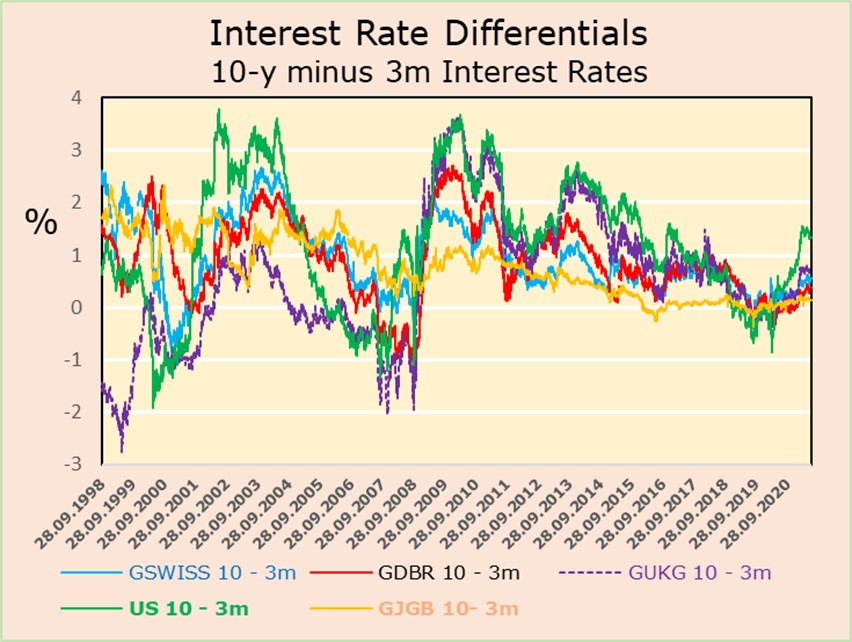
Before assessing the current situation let us examine the developments of interest rates. In the following chart we find a significant correlation between the 3-months rate and the 10-year bond yields.

The chart speaks for itself. It does not look very telling for the near-to-mid-term outlook, doesn’t it?

“Assessment through the looking glass”

Although the focus in this EMR is on inflation, we would argue that the outlook for productivity is the most crucial determinant for overall economic activity, interest rates, inflation and foreign trade. We argue that expanding and contracting credit demand has a much larger impact on short- and long-term interest rates than anything else.

We will therefore try to present a possible outcome in order to be able to define a promising investment strategy. The focus of our consideration is on the “power to tax”, which could end up as the “power to destroy”. In a capitalist environment, companies should not be excessively taxed to discourage the employment level of highly productive units that end up paying the price for policy missteps.

Pervasive socio-economic change

There is no doubt that we are faced with a new set of arguments primarily due to pervasive socio-economic change, a tendency to socialism and the implications of Covid-19. Economies in the developed world are driven in the short term by the multiple responses to the Covid-19 pandemic, while in the medium-to-long term they remain a function of technological advantage. It must be reckoned that the commonly used definition of productivity is output per man hour. Currently it is progressively determined by energy productivity and even more so by capital productivity.

The widespread, politically motivated assumption is that certain business owners should absorb these higher labor costs by cutting profits. However, since management and investors are usually not enthusiastic about this alternative, they will either try to raise prices to compensate for the increased costs or reduce employment, which will contribute to lower income growth. Neither option seems to make much sense at a time of “competitive disruption”, i.e. declining imports from low-wage countries. Nor does switching to cheaper substitutes seem to be a viable alternative. This seems to indicate that the fear of cost-driving inflation exists but is not as sustainable as generally expected. The switch to cheaper substitutes does not seem a feasible alternative either. What this seems to suggest is that fears of cost-push inflation exists but somehow not as sustained as widely feared or even expected.

In addition, based on the considerations outlined above, we believe that the decisive factor is and will remain the return to local production relationships! The struggle between the USA, Europe and China is obvious. Dependence on a producer with a ‘slightly’ different attitude than we are used to do business can no longer be accepted. Currently the outlook is also driven by the impact of Covid-19. It is a fact that labor productivity in the USA increased rapidly during the pandemic compared with the previous decade. However, it is unlikely that this rapid pace will continue. Similar to the Great Recession, the main reasons for the strong productivity growth now are cyclical effects that are likely to dissipate as the economy continues to recover. For example, as the number of workers has fallen, capital per worker has increased, raising “labor productivity” , i.e. including energy productivity and capital productivity. How the pandemic itself will impact productivity remains to be seen.

Our approach to economic growth makes it clear that the extraordinary recent rise in productivity is primarily due to cyclical effects that are unlikely to last and could even reverse. While there is much speculation about how the pandemic itself will affect productivity, it is too early to reliably assess how strong these effects will be in the long run.

The growth accounting shows that the main causes of the recent increase in productivity are cyclical and unlikely to last. In particular, the decline in employment has boosted capital deepening; the post-Great Recession experience suggests that this temporary boost is likely to reverse. Moreover, because the employment decline was more pronounced among workers with less education and experience, the average job quality of those who kept their jobs rose. This effect has already begun to reverse and may reverse further as less skilled workers return to work.

Conclusions for investors

The chart of the selected exchange rates on a monthly rate since 1971 does not yet points to an imminent change. Does the spending spree of the new US Administration tell us something, that we don`t know yet?

Our conclusions, are to be seen as a specific consequence of an extraordinary shift towards technological innovation away from traditional “output per man-hour”.

It also implies that even if inflation would narrowly fluctuate around 2%, historically seen, equities would continue to outperform fixed income securities and money market instruments.

Consequently, the USD is expected to rise vs. EUR, YEN, and GBP.

Keeping in mind that versus the USD, the CHF, the EUR and the JPY have fluctuated withing rather narrow bands, at this juncture we see no impending dangerous clouds in the currency sky.

Any suggestion is highly welcome.
Facebooktwitterlinkedinmail

Global minimum tax deal

EMR August 2021

The introduction of a global minimum tax for companies is being hotly debated in OECD circles. Therefore we ask ourselves the following questions in this EMR: Which influences will it have on production, consumption and international trade? Will inflation be driven by this tax? What does a cyclical comparison say about this? What effects can be expected for large and small countries? Which asset classes are promising?

Assessment

From the historic point of view, it is not surprising to understand why most commentators view as obvious immediate effects of tariffs or quotas to determine the tendency of prices to equilibrate among trading partners. With trade barriers, relative goods prices are no longer expected to be equal in the various countries. The aim of this EMR is to quantify as much as possible the impact of the global minimum tax of at least 15% now being publicly discussed. As we understand it, the proposals are to make the world`s biggest companies pay taxes in countries where they have significant sales but no physical headquarters. So far, we have not come across quantified expectations on the repercussions on equity prices.

Impacts on demand and supply

The real question is what are the repercussions of the agreement of a large number of nations to support the U.S. proposal (of Treasury Secretary Janet Yellen) to a global minimum tax of corporations? No doubt such an agreement represents a turnaround in the international tax competition. Expectations are that such a tax ought to determine or alter the relative price of the impacted goods. Respective impacts are expected regarding production, consumption and international trade. Theoretically it is rather easy to point to the respective impacts on the demand and supply curves, while empirically it remains a tricky attempt. Assuming that theoretically the amount of the “specific” good exported or imported at a given price (before the leaving of the new tax) is determined by the difference between demand and supply, what will be the impact of the 15% minimum tax deal? The available information depends on a working assumption that the demand curve either lies to the right of the supply curve (pointing to excess demand), at a given price, implying the availability of exports. On the other side if the demand curve lies to the left of the supply curve, at a given price, more of the taxed good is produced domestically than consumed, pointing to the availability of exports.

One of the major difficulties regarding the impact of the global minimum tax deal refers to disparities of the differential data basis on which the percent tax is levied. What effect will the tax have on the various countries? The immediate effect of the global deal tax is to create separate prices from country to country. The impacts are on the one hand differentiated expectations concerning the rate of inflation and on the other hand alter the trade relations. The exact change in the relative price and the level of trade depends on the slopes of the supply and demand curves, defining the marginal rates of transformation in production in the respective countries. The slope of the supply curve corresponds to the change in price necessary to induce a change in the quantity supplied. Similarly, the slope of the demand curve corresponds to the community indifference curves. These my summary comments are sufficient to explain the dichotomous interpretations available regarding the potential effects on inflation, economic activity and exchange rates. An environment speaking of sizeable volatility on the financial markets.

What are the costs of the mimnimu tax for a small country?

No doubt the proposed tax increase will change the relative price of the good on which the tax is levied. The outcome will preponderantly concern the relative price of production as well as the domestic relative price in consumption. Given that a small country has only a very limited power to affect the terms of trade the tax is expected to create a wedge between the domestic relative price in production and consumption. The result ought to be a reduction of production as well as consumption. Taxing exports raises the price of the county buying the respective good causing the relative price to be altered. A possibility that the country imposing the tax calls for an increment of the wedge for the receiving country. The wedge favors the exporting country to the detriment of the importing country. The impact of a tax is highly difficult to quantify when income, tastes and technology changes frequently, as is currently the case. A surge or decline in domestic demand must be relieved through domestic price and quantity adjustments. Domestic price fluctuations therefore must not always coincide with world price fluctuations.

Inflation differences*

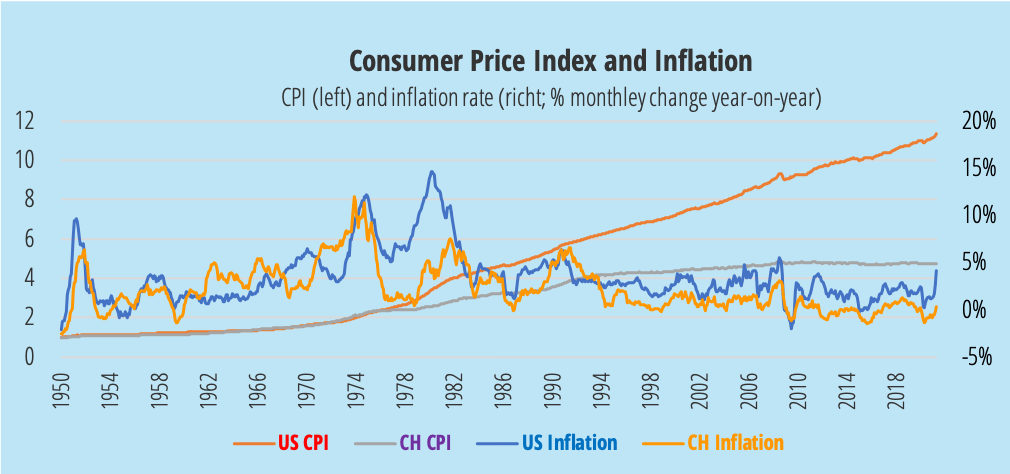
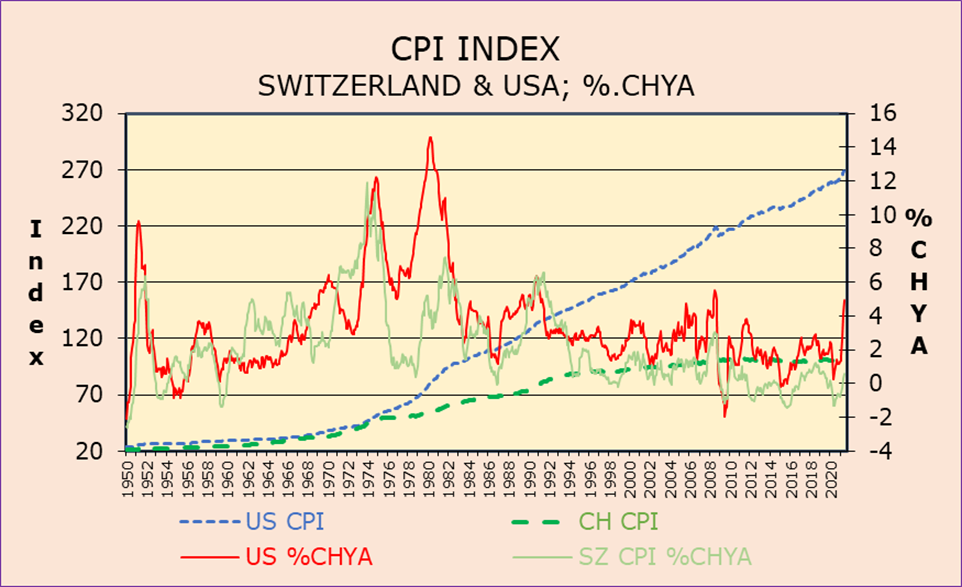
The below shown charts on the monthly CPI inflation for the USA and Switzerland for the period since 1950, and the respective percent changes on a yearly basis, point to known disparities. The trend graph for Switzerland points to similar interpretative difficulties. We assume that these differences from country to country are unlikely to be significantly changed by the announced global minimum tax. This primarily due to production and consumer differences and implicit inefficiencies. It seems highly advisable to us to examine the inflation charts in greater detail. The disparities have always been sizeable not only between the USA and Switzerland but also regarding many other nations.

Examining past events, we find sizeable differences of recent developments as compared, e.g. to the late 1970´s – early 1980`s and for the years 2008 – 2009. Of forecasting importance is that the trend growth of the indexes do not point to the changes in the monthly data! In addition there are sizeable cyclical differences. 1970 and 1975 have been scary indeed. Given the above-mentioned uncertainties regarding the expected reactions of producers and consumers to the global minimum tax deal, we come to the conclusion that the outlook is somehow uncertain but not catastrophic as widely assumed.

Conclusions for investors

Our conclusions, are to be seen as a specific consequence both of a production and consumption distortion. An international trade intervention, like the global minimum tax deal, is meant to solve both distortions. The main aim is to reduce the dependence form imports from low-cost producers, mainly from China. What we know is that it will take more time than assumed by the responsible politicians, and this due to the fact that increasing domestic production will take time. Today´s setting is significantly more complex than e.g. it has been in the case of steel imports in 1977. In addition, we assume that the global minimum tax deal may not be the best way to eliminate the inequalities, given that the tax deal may reduce world welfare by reducing the level of satisfaction of foreign countries more than the satisfaction gain to the domestic country.

In terms of the investment strategy, we believe that the “political induced approach” simply calls for a prolongation of the period of uncertainty and volatility. Why, you may ask? Well, the proposed policy does not address the DISTORTIONS mentioned above. The primary purpose of levying taxes is to finance government deficits, without significantly improving output and productivity and/or to increase consumption and employment in a timely manner. Consequently, we continue to see potential in the stock markets compared to fixed income and money market investments. Currency hedging will have to be considered in the international portfolio diversification approach.

Any suggestion is highly welcome.


* Environmental influences such as heat waves, depletion of water resources and fires, or floods and storms are not taken into account.

Facebooktwitterlinkedinmail

Types of distortions

EMR July 2021

Upheavals

Not only as a result of the COVID 19 pandemic, investors and also the public at large, are experiencing a trend reversal, away from free trade via the introduction of a new global minimum tax rate of 15%, with the aim of generating even higher revenues for the government.

At stake are the benefits of free trade through the institution of politically induced changes in relative prices.

Policy interventions to correct distorted distortions

TYPES OF DISTORTIONS: In this issue all price ratios are referred as terms of trade, although with specific qualifications.

We define the rate at which goods may be exchanges domestically in production as the marginal rate of transformation in production (TTP).

The rate at which goods may be exchanged domestically in consumption is defined as the marginal rate of substitution in consumption (TTC).

The rate at which goods may be exchanged through international trade relations is referred to as the foreign terms of trade (FTT).

What says the economic theory hereabout?

The argument put forward by various political entities calls for corporations around the world to pay at least a 15% tax on their earnings. The final rate could go even higher than that, as here and there the 15% is meant as a “floor”. Such a policy e.g., in the case of the USA, is a dramatic and dangerous policy reversal as compared to the policy advanced by the previous Administration. This “political jargonizing” is meant to discourage companies from relocation domiciles to foreign countries.

This “political approach” could have far-reaching economic effects, as not all countries will participate and thus trade conditions could be distorted. In addition, we see important implications for the domestic side of the economy as well as the international side.

Let us thus return to the implications on TTP, TTC and FTT. Following Bhagwati et al.[1] in the sixties and early seventies one can summarize the dangerous distortions as into the following three categories: production, consumption and foreign trade distortions.

The current discussion has not yet focused on the real implications of this political exercise. A production distortion results when the marginal cost to a business of a specific good differs from the cost to society (domestic and international). In terms of the above quoted abbreviations the result of the proposed tax may be defined as TTP ≠ FTT = TTC. At this stage it is impossible to quantify the cost of the singly enterprise vs. those of each country. In other words which are the marginal costs for an enterprise point of view vs the marginal costs from the society`s point of view?

A further distortion can be seen in the context of the marginal rate of substitution in consumption i.e., TTC ≠ FTT = TTP. Assuming that the envisaged policy distorts consumption to the community vs. the goods that can be exchanged in the world markets, one can assume that the price ratio facing the local community would undoubtedly differ from the relative value to individuals.

Surely enough there will also be trade distortions. In the above context we portray the trade distortion as FTT ≠ TTP = TTC.

Summarizing, we ask the following question: What is the result of the proposed tax increase if either a production or consumption (or in the worst case both) distortion(s) exist? No doubt the nature of the distortion must be determined. At least over the short to medium term we thus remain confronted with sizeable market volatility. In addition, we must recon with differential repercussions in the case that a country has market power or hasn`t enough market power, because market power allows a country to render its exports of goods. The argument speaks either of technical advantage or disadvantages. A recent example is the development of electronic semiconductors.

Disturbing at this crossing is what Treasury Secretary Janet Yellen said “that the international tax architecture must be stabilized, that the global playing field must be fair, and that we must create an environment in which countries work together to maintain our tax bases and ensure the global tax system is equitable and equipped to meet the needs of for the 21st century global economy.”

Nice words, but who will and can accept simply to follow the interest of large entities like the USA, China, and the EU. Is there enough room for countries like Switzerland to follow their own needs and requirements? The news came following meetings with a steering group within the Organization for Economic Cooperation and Development that the Treasury said featured “earnest” talks of a global tax? Somehow, we doubt it.

Nature of the recent distortions

Notably the distortions are both domestic as well international. Domestically they concern consumer and production inefficiencies, while internationally we see it in the growing discrepancies between exports and imports growth putting pressure on the negative and still growing international trade imbalances. In this context we ask ourselves if the proposed tax increase of 15% is the necessary and sufficient policy to cure the distortions? We believe that the nature of the distortion lies mainly in the international trade imbalances, although their impact is concentrated mainly on production and productivity. In the context of the “low-cost producer”, China, it should be remembered that it does not have to abide by international rules and regulations. At the top of the list is a production distortion of which there is no equal history. The price of imports from low-cost countries hinders, in due turn, the production lines of the industrialized world. The result is undoubtedly a currency readjustment. In the midst of the recent developments governmental indebtedness has skyrocketed. In other words, public and entrepreneurial indebtedness cannot be solved with a unilateral 15% tax increase.

In. Table 1.1. Intl. Trade

It is worth noticing that the major distortion in the US Foreign Trade data concern primarily the balance of goods. The US are undoubtedly the importer of last resort.

In MS&I
In 2021 Zinsdifferenzen

Conclusions for investors

Our conclusions are to be seen as a specific consequence of an extraordinary accumulation of governmental indebtedness and the “Covid-19 opening”. We are not aware of any comparable past period, thus have difficulties in being specific about future developments. Economic challenges are not easy to quantify either in the short or medium to long term. Consequently, we will focus our attention to the short-term. No doubt, the financial sector remains crucial for a smooth functioning of the world economy. Consequently, we assume – as a working hypothesis – that the measures ought to have an impact on inflation preponderantly over a longer period of time. In our investment outlook we also focus on the change in international trade flows, as we must reckon with a new fact, i.e. that the U.S. will increasingly cease to be the “buyer (i.e. the importer) of last resort”. In our scenario domestic economic growth gains in importance as an indicator for the financial markets’ whereabouts.

Consequently, we do not expect a sharp longer-term increase in inflation, as it cannot simply be passed on, neither domestically nor to foreign countries. As a working consequence we continue to see potential in the stock markets compared to fixed income and money market investments. Currency hedging will have to be considered in the international portfolio diversification approach.

Overall, we fear that the current “political induced approach” simply calls for a prolongation of the period of uncertainty and volatility. Why, you may ask? Well, the proposed policy does not address the DISTORTIONS mentioned above. The primary purpose of levying taxes is to finance government deficits without significantly improving output and productivity and/or to increase consumption and employment in a timely manner.

Any suggestion is highly welcome.
1 Jagdish Bhagwati. The Generalized Theory of Distortions and Welfare, 1969 (https://dspace.mit.edu/bitstream/handle/1721.1/63654/generalizedtheor00bhag.pdf)

Facebooktwitterlinkedinmail

Real GDP and Inflation?

EMR June 2021

En Vogue

The economy is expected to rise as the Covid-Pandemic measures are increasingly relaxed. Inflation is feared to rise significantly. Who will play the “revitalizer of last resort”?

Difficult to compare cycles

Argument 1: Whenever economic demand, however measured, rises significantly so do inflation expectations. Concomitantly it is also argued that in such a case monetary policy is tightened, i.e. interest rates are pushed higher.

Argument 2: Differential interpretations complicate Argument 1. Does growth rise, due to domestic activity or is it due to a significant reduction of imports of goods and services?

Argument 3: What about fiscal expansion i.e., extreme intervention by the Administration e.g., in the USA?

What can be inferred from past developments?

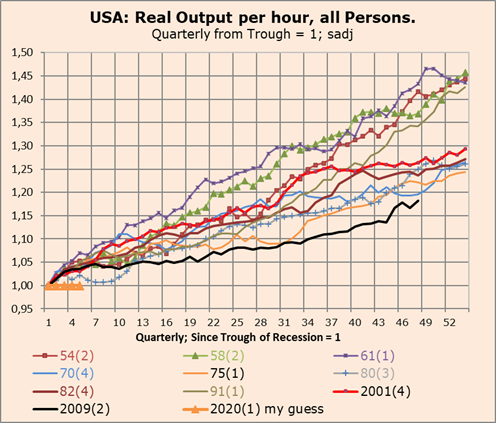
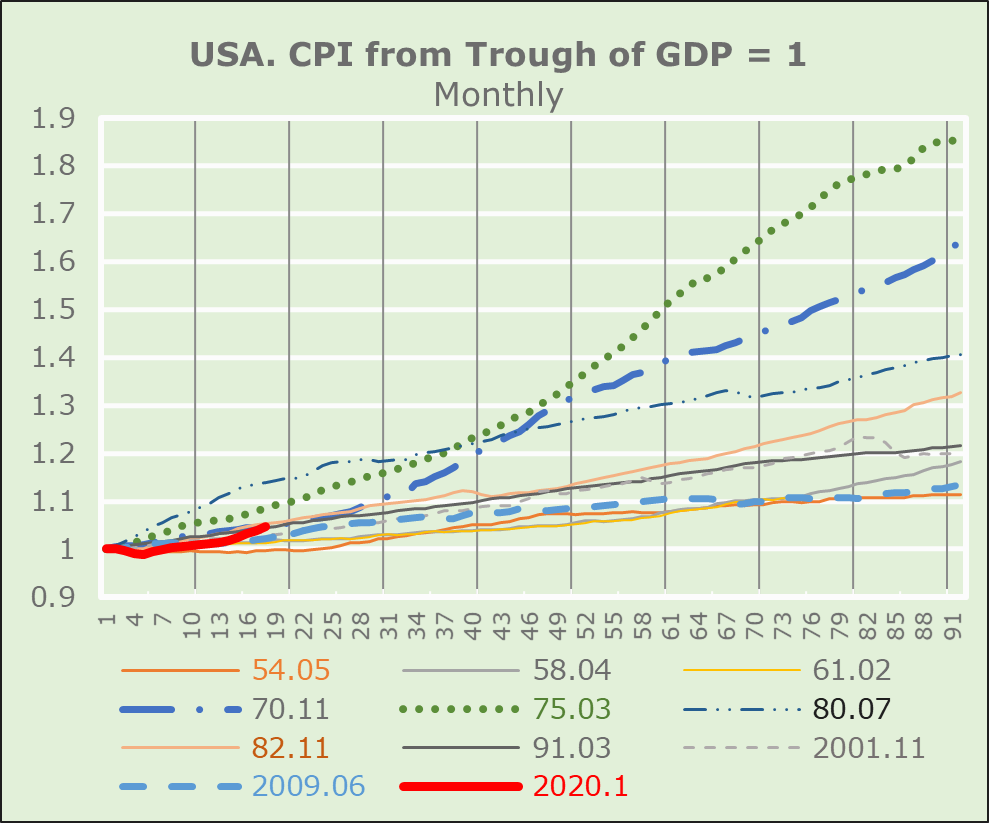
On real output: Examining the developments of the leading economy over business cycles since 1949 is indeed intriguing. The trend in real GDP, from each cyclical low, indexed to 1, is an indicator of considerable vulnerability, which in turn complicates the comparability effort. After the second year of economic recovery, discrepancies, from cycle to cycle, begin to grow ever larger. Currently, we assume that growth will be significantly more front-loaded than in most previous upswings. This due to the reduction of the Covid restrictions as well as the extreme expansionary monetary and fiscal measures. We believe that this phase will not last for long. Rising demand speaks also for significant demand for cheaper imports. At this juncture one must take into account that each country’s growth expectations ought not to be synchronous, given the specificities of each country, regarding the domestic as well as the foreign trade actions and reactions.

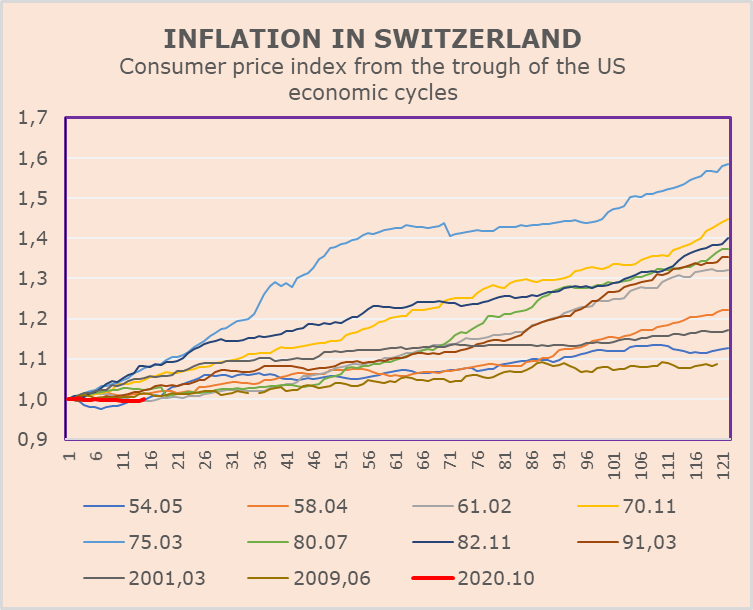
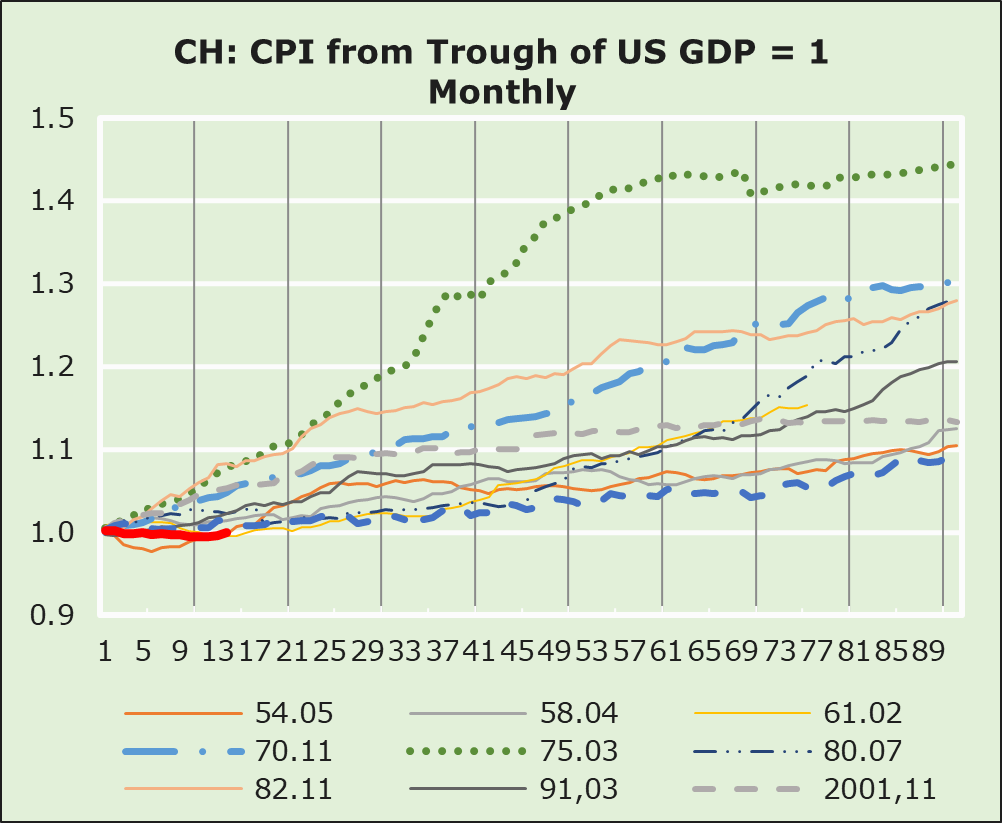
On inflation: Charting the US CPI (Consumer Price index) on a monthly basis, but coherently with the respective quarter of Output (see Chart on CPI from the Trough = 1) we find significant differences.

The period before the rate of growth of inflation starts to rise significantly is somehow longer than for real GDP, even taking into account that the data of real GDP are on quarterly basis, while the CPI data are on a monthly basis. This implies that the cyclical correlation of Output and CPI isn’t as close as often and regularly reported in the media. This is particularly evident in the three growth cycles in 1975, 1970 and 1980!

Examining the chart on the level of inflation and the corresponding yearly percent change for the USA and Switzerland we face a dilemma of “comparability”. The US CPI Index rose form 24.01 on January 1949 to 266.83 in April 2021. This shows an increase of 1011.3%. Over the same period, the Swiss CPI rose from 21.73 to 100.58 for an increase of only 362,9%. What do these figures imply? Well, they simply imply that the economic, social and political dissimilarities must be taken seriously into consideration, while pinpointing the coming quarters and years. Specific new determinants of the current outlook, as compared to the historic reality (see charts) is, that the USA are now an important producer of crude oil. A further determining aspect is that the technological developments remain considerably differentiated from country to country. Thus, we ought to pay attention to the possible differential repercussions on production, prices and expectations in general. At this juncture the question remains which are the sources of the rising pessimism?

At this juncture we expect the economy to react strongly to the monetary and fiscal policy measures and thus, anticipate that the feared effects will – for some time – cause unease among consumers and producers. The consumer`s contribution is not expected to be strongly positive, and this for the following reasons. Firstly, reserves will have to be rebuilt, i.e. debt will have to be significantly reduced. In addition, we expect consumers to switch to cheaper imports, which will further exacerbate the trade imbalances, e.g. in the case of the USA. In addition, we are concerned that the impact on domestic production may not provide the support necessary for political leadership to calm market volatility and uncertainty.

From an analytical point of view, political upheavals, possibly leading to even greater uncertainty, look highly problematic to us. It is to be feared that, in the event of higher taxation, producers will not expand production domestically but in “lower-cost” foreign countries, a move that would not help to reduce foreign trade imbalances.

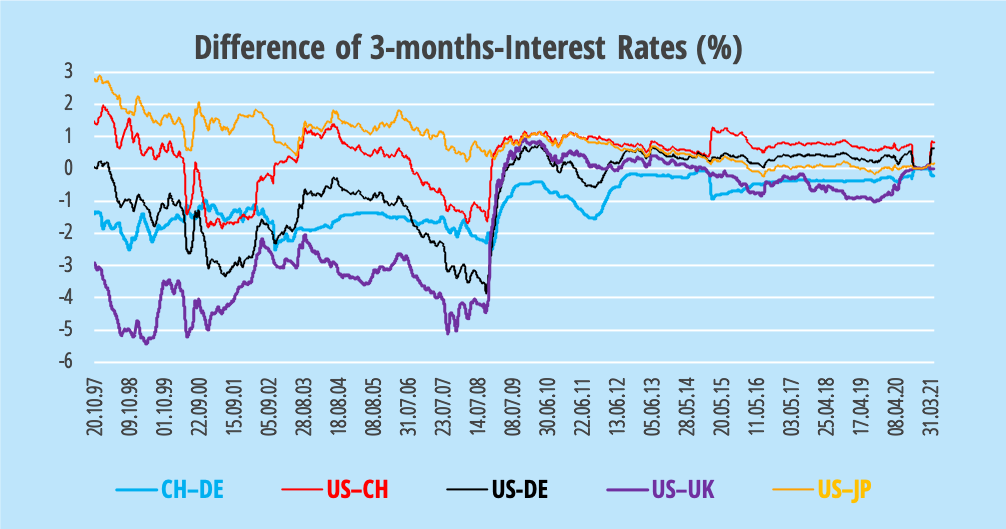
On interest rates: While the trend in 10-year bond rates is approaching a low point, the interest rate differentials in 3-month rates remain quite stable. Is this a necessary and sufficient reason why many analysts have now switched to inflation expectations as the most promising determinant? It is to be expected that monetary and fiscal policy measures will promote liquidity in the system. We wonder however, whether it is sufficient to rely only on the supply side as an explanatory motive, ignoring the effects on the demand side. The argument implies that one can led the horse to the well, while it remains an open question whether the horse will drink.

Implications: What we are suggesting is nothing more than how consumers and producers will react to the increase in liquidity? We doubt that consumers will increase their spending without paying attention to prices. In other words, we continue to assume that consumers will remain “price-conscious”, especially regarding cheaper imports! This “leaves” economic growth as the potential “inflation driver”. Here however, we have to reckon with a lag that is still very difficult to quantify at this juncture.

Conclusions for investors

Our conclusions are to be seen as a specific consequence of an extraordinary accumulation of governmental indebtedness. We are not aware of any comparable past period, thus have difficulties in being specific about future developments. Our view is that we remain confronted with a highly difficult to quantify financial landscape. No doubt, the financial sector remains crucial for a smooth functioning of the world economy. Consequently, we assume – as a working proposition – that the measures ought to have an impact on inflation preponderantly over a longer period of time. In our investment outlook we also focus on the change in international trade flows, as we must reckon with a new fact, i.e. that the U.S. will increasingly cease to be the “buyer of last resort” (i.e. the importer). In our scenario domestic economic growth gains in importance as an indicator for the financial markets’ whereabouts.

Consequently, we do not expect a sharp increase in inflation, as it cannot simply be passed on, neither domestically nor to foreign countries. As a working consequence we continue to see potential in the stock markets compared to fixed income and money market investments. Currency hedging will have to be considered in the international portfolio diversification approach.

Any suggestion is highly welcome.
Facebooktwitterlinkedinmail

Will interest rates go up?

EMR Mai 2021

The high level of monetary and fiscal policy interventions by the USA and also by European countries are the cause of rising inflation and interest rate expectations. They cloud the prospects for the long-awaited economic recovery. The corona pandemic also unsettles market participants and the state. Many analysts therefore believe that both inflation and interest rates will rise, which in turn will darken the stock market outlook. In contrast, we do not expect any significant increases in inflation and interest rates. There is therefore still potential on the stock exchanges. We explain why in this issue of the EMR.

What’s behind it?

Fiscal policy measures are intended to inject liquidity into the economy and to bring the economy back on track for growth by stimulating consumption. On the one hand, it is assumed that the manufacturing sector will benefit greatly from the easing of fiscal policy. On the other hand, announced tax increases are hampering local investment activity. We analyze expectations and possible or feared shocks.

The general assumption is that the economy reacts strongly to monetary and fiscal policy measures. In our case, however, it can be assumed that the effects of the government measures will tend to cause unrest among consumers and producers. A contribution to growth from consumption is hardly to be expected, since debts have to be reduced first. In addition, we expect that consumers will initially turn to cheaper imported goods. In the case of the US, this would further worsen the trade imbalance. This has an impact on domestic production and this in turn will unsettle the political leadership. The longed-for reassurance will not materialize. Political upheavals can lead to even greater uncertainty and, with higher taxation, cause companies to increase their production not domestically but in cheaper foreign countries.

What do we learn from the development so far?

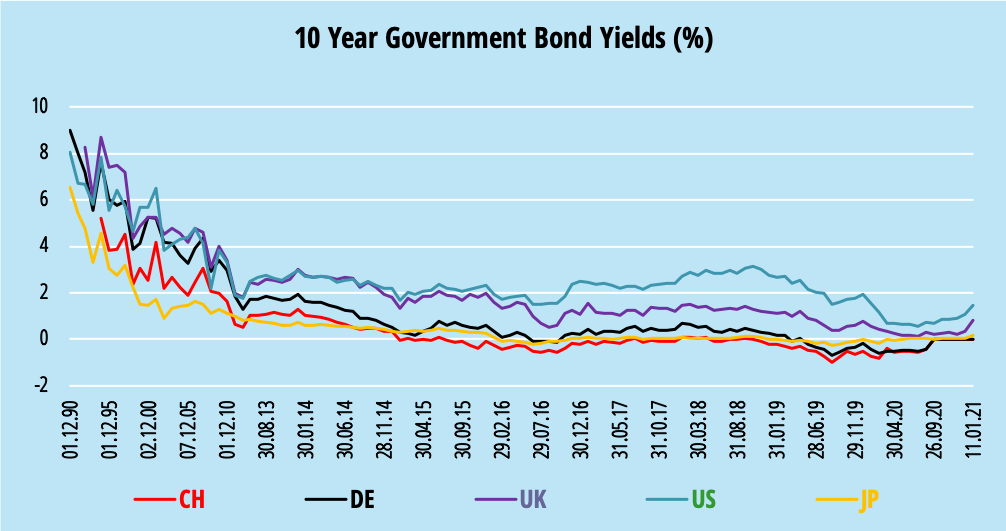
While the interest rate trend for 10-year bonds is approaching its lowest point, the interest rate differential for 3-month rates has remained relatively stable since the 2008 financial crisis. Is this one reason why many analysts predict rising inflation and interest rates? Monetary and fiscal policy measures will further increase liquidity in the economic system. As is well known, however, you can lead the horses to the well, they have to drink themselves. So it is not enough just to look at the supply side. The question is, will both consumers and producers react to the increase in liquidity? We doubt that consumers will increase their spending without paying attention to prices. We assume that consumers will remain price-conscious and buy cheaper imported goods. That leaves entrepreneurs as a potential driver of inflation. Here, however, a delay that is difficult to determine must be expected.

A comparison of the development of consumer prices in Switzerland and the USA shows that it is difficult to derive future inflation developments from this. The difference between the development of the consumer price indices and the inflation rate is obvious. It is striking that the inflation rate has tended to decrease since the 1990s!

The inflation rate in Switzerland has been slightly negative since November 1919 (average -0.57%) while it has remained positive in the USA (average 1.49%) and was 2.64% last March. At this point in time, one could well imagine that the US inflation rate will continue to rise in the same way as in 2007-2008 and could rise to over 5%. Such an increase would, however, have a strong negative impact on economic development. But that cannot be assumed given the currently extremely expansive monetary and fiscal policy. In such a situation, a dramatic currency adjustment would probably be expected, which would result in strong reactions not only in terms of economic policy but also in terms of investment policy.

What does this mean for investors?

In our context, the enormous increase in national debt should also be mentioned. In Europe as in the USA, the debt ratio is rising steadily. In the USA, it rose from 63% at the end of 2007 to 105% at the end of 2019, only to skyrocket to 131% at the end of 2020, mainly due to Corona measures. We are not aware of any similar period. We therefore assume that the measures will only really come into play over a longer period of time. We focus on changing international trade flows. The USA will increasingly no longer play the role of the buyer “of last resort”. Thus, domestic demand growth should gain in importance for the financial markets.
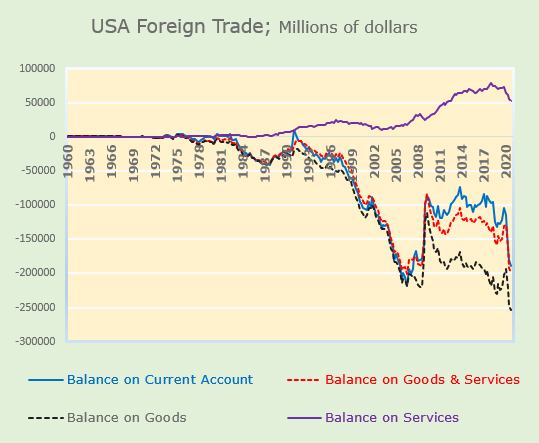
Based on the considerations mentioned above, we expect that inflation will not really pick up and that the financial markets will not be subject to any major changes. We therefore continue to see potential on the stock exchanges compared to fixed-income and money market investments.

Facebooktwitterlinkedinmail