
EMR August 2026
Dear Reader
It is well known that the explanation of economic crises takes place in quite different contexts. Today’s specific difficulties for investors relate to the timing of relevant policy actions and/or reactions.
[2 .6.2026=”1″][2 .6.2026=”1″]A pertinent example is shown by the performance of selected equity indexes, see following chart. Somehow, we are rather surprised by the overall performance of the Nikkei index (last top of 2.168, on the indexed basis [2.6.2026 = 1]; as well as the Nasdaq index 1.835 on [2.06.2026 = 1]). The growth disparities with the other indexes are even larger.
The coherent tricky question refers to which are the causes of the evident disparities.
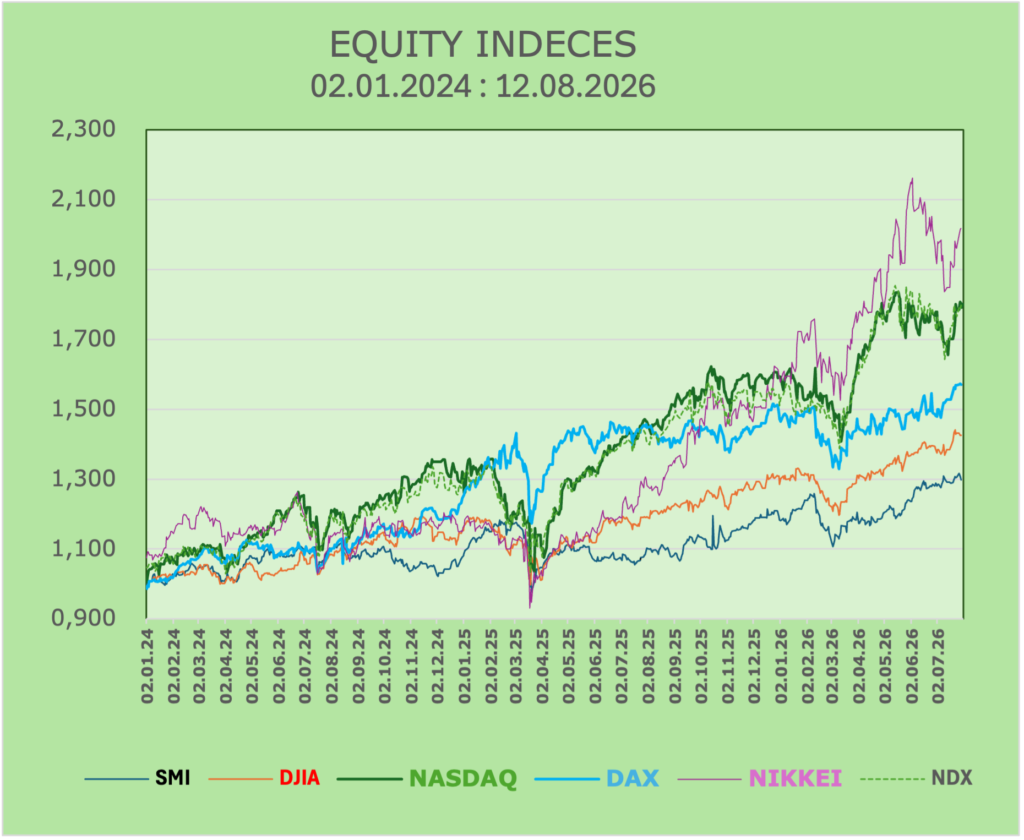
Analyzing closely the developments of the shown equity indexes, we can deduce the following deterministic factors:
- In order to facilitate the assessment of the shown indices, we defined each index to 1, as of January 2, 2024. Two rather distinct phases are discernable in the chart: The first ranging from January 2, 2024 to early April 2026; the second for the period since April 2025.
- Overall, the trend-developments have been more pronounced, in the second phase, pointing to growing fears, concerning e.g. further feared military interventions, primarily in Eastern Europe and the Middle East.
- The worst performer has surprisingly been the SMI, while the best – in both phases – have been the NIKKEI, followed by the NASDAQ index.
- Inflation persists as a principal troublemaker.
- Our assessment of shorter-terms trends is relatively intriguing, and difficult to quantify with enough precision.
As already mentioned, astonishing are the outperformances of the NIKKEI and of the NASDAQ indexes. Any suggestion why so? Inflation, interest rates or maybe technology?
We believe that both best-performing indexes are significantly more determined by technological developments, then by inflation and/or interest rate and political expectations, as well as interest rates manipulations. We wonder why a large majority of the influential politician and analysts have no interest to preponderantly set the focus on technological innovation, which we view as the primary determinant of things to come, as intrinsically shown in the above portrayed chart. If, at this point, readers might have a different opinion, we would kindly ask them, to let us know, how we ought to interpret the outperformances of the Nikkei and the Nasdaq? Thank you so much, in advance.
Returning to the surprising recent political, social and predominantly economic developments, let us focus on specific differences.
Due to the known volatility, beyond some similarities, we recognize specific differing index performances. While the two phases perform rather similarly, the divergences are nevertheless significantly more pronounced in the second phase. Why so, is the real question, requiring a pertinent answer.
CONCLUSIONS
A specific determinant, difficult to assess properly, concerns the political focus of various actors. Despite the long-standing manipulations of e.g. the price of crude oil, viewed as one of the primary determinants of the rate of inflation, another primary determinant at this point, is the progress of technology, which, in our opinion, does not get the appropriate attention.
Focusing on inflation and on interest rates, while the real mover has been, is, and will continue to be technology is indeed problematic.
Contextually, the chart on indexes is telling indeed. We have disagreed and persist in doing so, with this public approach and remain of the opinion that technology advances might persist as the primary determinant, for some more time to come. Once again let us stress the fact that technological developments are and will continue to preponderantly determine the economic developments, significantly more than the jargon of most politicians.
A further impact that does not get the proper attention – is and ought to remain – the impact on economic activity especially regarding return on investment, both domestically and internationally. In other words, we ask ourselves who sits in the driver’s seat: technologically driven economic activity, or politically determined jargon on inflation and interest rates? In other words, we ask ourselves who will be the winners?
The outlook is generally pointing to economic growth, while remaining rather difficult to be credibly quantifiable. Recently, analysts argued either along the lines of energy imports or based on global technological developments. Economic activity is, despite all forecasting difficulties, a vital barometer of “economic health”, influencing most everything from fiscal and monetary policy and thus also the investment policy. For us, as investors it requires an ever-demanding and ever-growing assessment of the vulnerability of politicians as well as of investors. Contextually, there are questions we cannot quantify, regarding e.g. when and on which mutually agreed conditions, might make the forecasting exercise rather credible and hopefully rewarding?
ADDENDUM
The ongoing water shortage requires quantification of the durations of the drought, which in turn determines the severity of the recession – something we cannot quantify at this time. Nevertheless, we expect a significant increase in inflation in the short to medium term, with the corresponding negative impact on economic activity.
NEVERTHELESS, WE ASSUME THAT SHORT-TO-MEDIUM-TERM INFLATION WILL BE HIGHER, AND ECONOMIC GROWTH SIGNIFICANTLY LOWER, REQUIERING CONTINUOUS ASSESSMENT FOR THE SELECTIION OF EQUITIES AND CURRENCIES.